Monday, June 20, 2016

Injustices that the Prophet Amos Excoriated a Reality in Australia


2016-06-18_0049


Part Three:
Song for George Bender


by


Damien F. Mackey


TV program, 60 Minutes looked at the battleground between Queensland farmers

and coal seam gas companies.


Keep Out!


What would you do if someone walked into your backyard, dug a big hole and put a fence around it with a sign saying ‘No Trespassing’? In all likelihood you’d shout and scream and call the police. But what if when the police came they threatened to arrest you, not those who wrecked your property and locked you out? In many parts of rural Australia this is the outrageous scenario now playing out between farmers and big gas companies, whose relentless – often ruthless – quest for new sources of gas seems to have no limits. In a special 60 Minutes investigation, Michael Usher reveals evidence showing the high-pressure, secret tactics used by some gas companies which are driving hard-working country folk from their land. Queensland farmer Kane Booth used to have a multi-million-dollar cattle business until three coal seam gas wells were drilled on his property. He says the wells affected the water supply on his land, rendering it useless for fattening his cattle. He’s now been forced to abandon the property and sell off his herd. Not surprisingly, Kane and his young family are devastated, but have vowed to fight on. However, a similar battle on a neighbouring property has had a tragic outcome. George Bender fought a coal seam gas company for years, blaming it for polluting his property. But it turned out to be a battle of attrition he was never going to win.


Reporter: Michael Usher

Producer: Laura Sparkes


Midnight Oil drummer Rob Hirst has written a song with his daughter Jay O’Shea which has had more than half a million hits on the web.

The song The Truth Walks Slowly (In The Countryside) is about Queensland farmer George Bender who committed suicide last year following a protracted battle with a coal seam gas mining companies, which mined his family’s fertile farmland.


http://i.dailymail.co.uk/i/pix/2014/11/30/239AB3C400000578-2854556-image-12_1417314703186.jpg


Lyrics


Mr Rose the cattleman wont let the miners on his land
He says this land is more than me I’m married to the property
Six generations call this home and this is where I’ll rest my bones
Beyond the tablelands you’ll see a line of blurred infinity
The truth walks slowly in the old man’s eyes
The truth walks slowly in the countryside

(the up and down the here and now the why the what the when the how)

the truth walks slowly
I’ll sting and bite and scratch the hand of those who’d come and waste this land
Their eyes are void their hearts are blank as empty as my watertank
I know this country rock and stream my sweat has washed the mountain clean
Now I am forced to make a stand cos I’m the one who loves this land

The truth walks slowly convictions slide
The truth walks slowly ‘long the riverside
The truth walks slowly it smells like dirt
the truth walks slowly there’ll be no mining in our rich black earth

The truth walks slowly
seems our lives go flashing by like lightning
seems these times are compromised by fighting
seems these times will be defined by coal seam mining
The truth walks slowly but greed runs fast
There’ll be no mining in our
golden grass.


Rob: vocals/drums/strums
Rick Grossman: bass
Rob Woolf: piano/vocals
Jason Millhouse: guitars
Eden Cutler & Erin Pascoe: chant
Stephen Baker: chant
Recorded by Brent Clark


http://nnimgt-a.akamaihd.net/transform/v1/crop/frm/storypad-Gh2LLJN5ZAAiRUxkHxKdH7/2eff37c3-b077-454c-8690-27374862bb19.jpg/r0_0_1857_1044_w1200_h678_fmax.jpg

Sunday, June 19, 2016

The world needs Christ more than ever, Pope Francis says

Amen #God #Jesus #Christ #JesusChrist #Lord #Savior #Creator #SonOfGod #Holy #TheCross #King ...
             
by Elise Harris

.- On Sunday Pope Francis said that with a growing sense of emptiness and insecurity gripping the world, Jesus Christ is needed more than ever before, since he alone knows how to answer humanity’s deepest questions.
“The world needs Christ more than ever, needs his salvation and his merciful love,” the Pope said June 19.
“Many people sense a void around and inside of them. Perhaps some of us too,” he said, noting that others “live in restlessness and insecurity because of precariousness and conflict.”
Each person needs to have “adequate responses” to their deepest existential questions, he said, explaining that since “Jesus knows the heart of man like no other,” he is able to heal and to give life and consolation to humanity.
Pope Francis spoke to pilgrims gathered in St. Peter’s Square for his Sunday Angelus address, which fell on same day as the opening of the June 19-26 Pan Orthodox Council in Crete. Cardinal Kurt Koch, President of the Pontifical Council for the Promotion of Christian Dialogue, has been tapped to be the Vatican’s observer at the council.
The Pope offered special greetings to the council participants, who also celebrated the solemnity of Pentecost – according to the Julian calendar – the day of the council’s opening.
He asked in pilgrims to unite in prayer “with our brother orthodox, invoking the Holy Spirit so that he assists with his gifts the Patriarchs, archbishops and bishops united in the Council,” and led them in praying Hail Mary.
In his speech before the Angelus, Francis focused on the day’s Gospel from Luke in which Jesus asks his disciples “Who do you say that I am?” – a question that Peter responds to with his declaration that Jesus is “the Christ of God.”
Jesus’ question is being repeated to each one of us today, Francis said, and asked aloud “Who is Jesus for the people of our time? For me, for you, for you, for you. Who is Jesus for each one of us?”
All of us are called “to make Peter’s response our response, professing with joy that Jesus is the Son of God, the eternal Word of the Father who became man to redeem mankind, pouring out upon him the abundance of divine mercy,” he said.
The Pope then pointed to how after Jesus speaks to the apostles, he addresses the entire crowd, telling them that “if one of you wishes to come after me, he must deny himself, take up his cross daily and follow me.”
This cross, Francis said, is not a mere “ornamental” or “ideological” cross, but rather consists of the daily sacrifices made for others – including parents, children, friends, relatives and even enemies – out of love.
It also involves the adoption of an attitude of solidarity, especially with the poor, and of commitment to working for justice and peace.
By assuming these attitudes, “you always lose something,” he said, but urged pilgrims to remember Jesus’ advice that “whoever loses their life (for Christ) will find it.”
“Therefore, let us confidently abandon ourselves to him: Jesus, our brother, friend and savior,” Francis said, adding that Christ, through the Holy Spirit, gives us the strength to grow in faith and to act on what we believe, rather than saying one thing and doing another.
He noted that the Virgin Mary “is always close to us and goes before us” on the path of faith, and prayed that all of us would take her hand “when we pass through the most dark and difficult moments.”
After reciting the Angelus prayer, Pope Francis noted how tomorrow, June 20, marks the U.N.’s World Day of Refugees, which this year holds the theme: “With refugees. We are on the side of those forced to flee.”
Refugees, he said, “are people like everyone else, but from whom war has taken their house, work, relatives and friends.”
“Because of this we wish to be with them: to meet them, to welcome them, to listen to them, to become with them artisans of peace according to the will of God,” Francis said, and wished pilgrims a happy Sunday before asking for their prayers.

....


Taken from: http://www.catholicnewsagency.com/news/the-world-needs-christ-more-than-ever-pope-francis-says-66922/


12K
0
12K


Thursday, June 16, 2016

From Skinhead Bulldog to Catholic Man of Letters

September 06, 2013
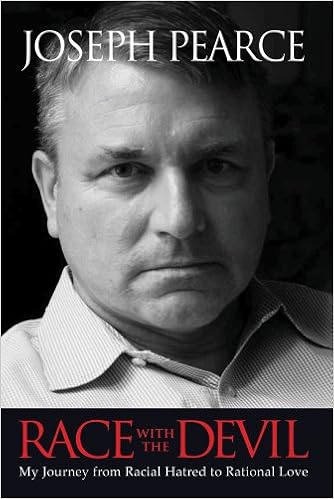
Joseph Pearce’s autobiography reveals his violent past and grace-filled conversion.
Joseph Pearce, as many who have read his work or seen him speak might testify, can give one the impression of a soft-handed, tweed-sporting, Oxford don who has spent the better part of his life among the dusty pages of a library, with his remaining hours spent drinking afternoon tea and sipping scotch in the evening. Pearce, author of many literary biographies and other books including Literary Converts, Wisdom and Innocence: A Life of G.K. Chesterton, and Tolkien: Man and Myth, appears to be the consummate English gentleman. Perhaps those with the knack of identifying an Englishman’s town of birth by his accent would not be fooled, but for most of us on this side of the pond, his blood seems practically blue. It turns out, however, that his blood is really more…well, orange.
In his latest offering, an autobiography, Race with the Devil: My Journey from Racial Hatred to Rational Love (St. Benedict’s Press), the donnish impression of Pearce quickly goes up in smoke. The book dispels almost instantly any stuffy image one may have ever entertained of the prolific author. Who knew the young Joe Pearce was a skinhead bulldog? Yes, you read those words right—a skinhead and a bulldog anxious for the fight.
His life began merrily enough in the English countryside with his parents and a younger brother, but when he moved to London for middle school, things got rough. His father’s racism and high regard for the Nazis, the chaos of an inner-city school, and his own clever pen opened the door to his early involvement—at the age of 15—with the National Front, a British-nationalist, white supremacist group. Pearce became the editor of the party’s newspaper, Bulldog, which extolled the virtues of the white race while calling for the expulsion of non-whites from Britain, as well as Catholics and Jews.
His work with the National Front eventually led to membership in the Protestant counterpart of the IRA in Northern Ireland—which heightened his own anti-Catholicism. He describes the intense experience of being an “Orangeman”:
As a loyal Orangeman, the highlight of the year was the annual Twelfth of July parade when the Orange Order celebrates the victory of the Protestant William of Orange against the Catholic King James II at the Battle of the Boyne in 1690. Although I had attended the English Twelfth in Southport, just north of Liverpool, the experi­ence was utterly eclipsed by my attendance at the mother of all Twelfth of July parades, held annually in Belfast, at which tens of thousands of Orangemen, accompanied by hundreds of flute and accordion bands, are cheered on by tens of thousands more who line the streets waving Union flags as the parade of Orange lodges passes by. There’s noth­ing like it and the memory still sends a primal, tribal thrill up my spine as I remember the beating of the drums and the sheer fervor and magnitude of the event. (p. 104-105)
As the book makes plain, it wasn’t just ink that was spilled during Pearce’s early days of rabble-rousing. The National Front demonstrations often became violent melees with counter demonstrators involving bricks, bottles, and any other handy projectile, and his own belligerence, fueled by alcohol, nearly got him killed on several occasions.
Pearce finally found himself in jail, although surprisingly not due directly to any violence, but on charges of publishing material in Bulldog likely to incite racial hatred. Not once, but twice. Under the unpopular Race Relations Act a jury found him guilty of “hate crimes,” which made Pearce something of a political martyr. During his incarceration, “Free Joe Pearce” was emblazoned in graffiti on walls, bridges, buildings, and overpasses around the country.
Pearce, while embroiled in the heated political battles of the 80s involving the IRA, terrorism, and racism, was also heavily engaged in the British music scene, much of which will be familiar to Americans of a certain age—Madness, The Clash, and Depeche Mode, all 80s chart toppers. His brother was the manager for the one-hit-wonder Soft Cell, known in the US mostly for “Tainted Love,” though Pearce’s own musical choices were punk and heavy metal. The book offers interesting insights into some of the politics associated with the British music scene in the 80s—much of which we Americas were oblivious to as we listened to our cassette tapes or watched videos on this new channel called MTV. Who knew there were such things as Rock Against Racism and Rock Against Communism?
I spoke with Pearce about the book a few months before reading it. My question was, why are we just hearing about his colorful past now? He explained that he wanted to wait until both of his parents had passed away out of respect for them. But he said he also needed the distance of years from the events of his youth in order to develop a mature perspective and to write truthfully and without saying simply, “See how bad I was.” People have, he explained, a balance of good in them, even when they are up to no good. He wanted that mixture to come through in the book. He is successfull, especially when he writes about his father and several friendships he developed along the way.
As the subtitle of his book suggests, Pearce did not have a dramatic conversion experience involving being knocked off any horse—though there was quite a lot of being knocked about; his was a long journey with small steps along the way. Many of the steps stand out, such as the moment he found himself in prison again at the age of 24, grasping a rosary someone had given him in court and trying to pray despite not knowing a single prayer. Or later, while making a sincere effort to be a church-goer and a good dad to his children, who lived in another village, he showed up drunk at the parish priest’s residence with nowhere to go after a long night of partying. (That must have been an awkward breakfast.) It seems he spent many years living these sorts of paradoxes—paradoxes that easily exist in lives of all of us sinners without an abundance of sacramental grace.
The spark to which Pearce gives credit for his conversion came from G.K. Chesterton. Pearce felt as though he had found a true friend in Chesterton’s writing, especially on economic issues, but simply dismissed the Catholic elements. Eventually, after having absorbed the goodness of Chesterton, Pearce began to wonder about that Catholic part, too. It didn’t take long before he was convinced of the truth of Catholicism, but living it proved to be much harder. It took years before he would finally enter the Church.
As Pearce made steps closer to the faith, he believed himself to be acting solely upon rational grounds. However, in hindsight, Pearce confesses that he can see the hand of Providence guiding him toward truth and goodness, as well as sparing his life on many occasions.
Like Pearce’s other books, Race with the Devil is a delight to read. It is also a source of great hope. Many small acts of great kindness that Pearce received during his journey left significant impressions upon the angry young man, which serves as a reminder that even the little things we do for others can have an impact beyond our wildest imaginings. As in Augustine’s Confessions, it was little moments of grace that made the difference in Pearce’s life: a generous police officer here, a thoughtful couple there. More than anything, however, Pearce’s autobiography is a testimony to the ever ancient, and yet so new, transforming power of grace.
….
Taken from: http://www.catholicworldreport.com/Item/2550/from_skinhead_bulldog_to_catholic_man