Sunday, November 25, 2018

A Kingdom of Truth not Power. Part Three: Love over political power


Image result for love over political power Jesus


Pope Francis noted that the feast of Christ the King “reminds us that the life of creation does not advance by chance, but proceeds towards a final goal:

the definitive manifestation of Christ, the Lord of history and of all creation.”

He said the end goal of history will be fulfilled in Christ’s eternal kingdom.


Pope Francis’s Angelus address for the feast of ‘Christ the King’ can be read at, for instance: https://www.vaticannews.va/en/pope/news/2018-11/pope-francis-angelus-christ-the-king-love.html


Pope at Angelus: ‘Jesus’ eternal kingdom founded on love’


Ahead of the Sunday Angelus prayer on the Solemnity of Christ the King, Pope Francis says Jesus came to establish an eternal kingdom which is founded on love and gives peace, freedom, and fullness of life.


By Devin Watkins


Pope Francis prayed the Angelus on Sunday with thousands of pilgrims huddled under umbrellas in a rainy St. Peter’s Square. He even complemented their courage. “You’re brave to have come with this rain!” he said.

In his address ahead of the Angelus prayer, the Holy Father reflected on the day’s Gospel passage (Jn 18:33b-37) and the Solemnity of Christ the King. He said Jesus’ kingdom rests on the power of love, since God is love.


Christ the King


Pope Francis noted that the feast of Christ the King “reminds us that the life of creation does not advance by chance, but proceeds towards a final goal: the definitive manifestation of Christ, the Lord of history and of all creation.” He said the end goal of history will be fulfilled in Christ’s eternal kingdom.


In the day’s Gospel, Jesus has been dragged – bound and humiliated – before Pontius Pilate to be tried. The Pope said the religious authorities of Jerusalem present Jesus to the Roman governor of Judea as one who is seeking to supplant the political authority of Rome. They say he wants to become king.

So Pilate interrogates him, twice asking Jesus if he is the king of the Jews. Jesus replies that his kingdom “is not of this world”.

“It was evident all his life that Jesus had no political ambitions,” the Pope said. He noted that, after the multiplication of the loaves, Jesus’ followers had wanted to proclaim him king and to overthrow the power of Rome, in order to restore the kingdom of Israel. Jesus responded, the Pope said, by retreating to the mountain alone to pray.


Love over political power


With his responses to Pilate, Pope Francis said Jesus “wants to make it clear that above political power there is another, much greater power, which is not achieved by human means.”

Jesus, he said, “came to earth to exercise this power, which is love, to testify to the truth.”

The Holy Father said this divine truth, “which is ultimately the central message of the Gospel”, is that “God is love” (1 Jn 4:8).

Pope Francis said Jesus worked to establish “his kingdom of love, justice, and peace in the world”. Jesus’ kingdom, the Pope said, will last until the end of time.


Saturday, November 24, 2018

Pope Francis: Sacred music points to the beauty of Paradise


Pope Francis meets with choir members and muscians Nov. 24, 2018. Credit: Vatican Media/CNA.
 

https://www.catholicnewsagency.com/news/pope-francis-sacred-music-points-to-the-beauty-of-paradise-21149

By Hannah Brockhaus
 
.- Liturgical and sacred music can be a powerful instrument of evangelization, because it gives people a glimpse of the beauty of heaven, Pope Francis said Saturday at an international meeting of choirs.
“Your music and your song are a true instrument of evangelization insofar as you witness to the profoundness of the Word of God that touches the hearts of people, and allow a celebration of the sacraments, especially of the Holy Eucharist, which makes one sense the beauty of Paradise,” the pope said Nov. 24.
“Never stop this commitment” to music, he emphasized, “such an important commitment to the life of our communities… In moments of joy and sadness, the Church is called to always be close to people, to offer them the company of faith.”
Music has the ability to make a deep impression on moments in people’s life, preserving them “as a precious memory that has marked their existence,” he noted.
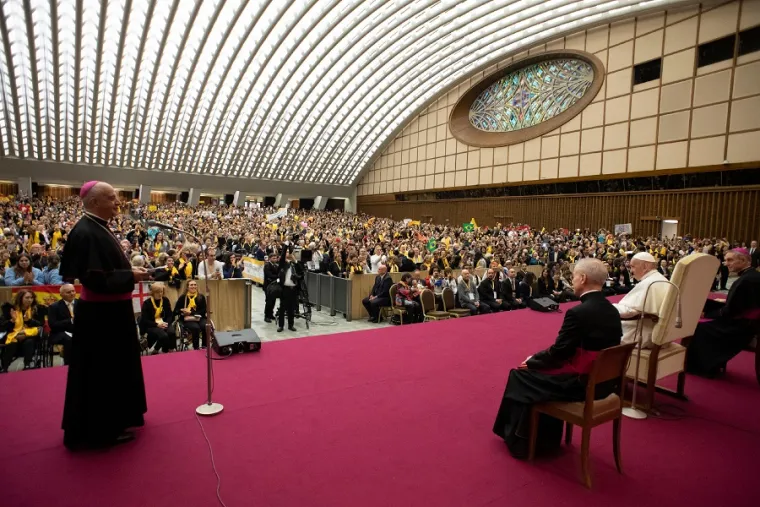
Pope Francis spoke in a meeting with over 8,000 singers and musicians from around the world, who are attending an international meeting of choirs at the Vatican Nov. 23-25.
The third edition of the conference, it began with talks on “Music in the Liturgy and Catechesis for the New Evangelization,” presented by Msgr. Marco Frisina, a renowned composer and founder and director of the Choir of the Diocese of Rome.
Other experts in sacred and liturgical music also gave presentations, including Msgr. Guido Marini, Pope Francis’ master of liturgical ceremonies.
The conference of choirs also had a moment for testimonies from singers and musicians from around the world, including Brazil, the Central African Republic, Mexico, Lebanon, Iraq, China, Vietnam, Turkey, and the United States.
The culmination of the meeting will be a choral concert in the afternoon Nov. 24, where participants will sing works by Palestrina, Mozart, Perosi, Handel, Vivaldi, and Bartolucci.
The event will conclude Nov. 25 with Mass in St. Peter’s Basilica followed by attendance at Pope Francis’ Sunday Angelus in St. Peter’s Square.
“Your presence,” the pope told the singers and musicians, “while highlighting the internationality of your respective countries, allows us to grasp the universality of the Church and its different traditions.”
“Your song and your music, especially in the celebration of the Eucharist, make it clear that we are one body and sing one faith with one voice. Even if we speak different languages, everyone can understand the music we sing, the faith we profess and the hope that we await,” he stated.
The pope encouraged musicians and singers to study and prepare so that they can accompany the liturgy well, and not be tempted to draw attention to themselves: “Please, do not be a ‘prima donna!’” he said.
Liturgical musicians, he said, should be “animators of the song of the whole assembly,” not replace it.
“Through these musical compositions and songs,” he said, “voice is also given to prayer and in this way a real international choir is formed, where in unison the praise and glory rises to the Father of all from his people.”
 

Sunday, November 18, 2018

The Cross of Jesus Christ – this is the “fifth essence”, the “philosopher’s stone”


Image result for jesus loves you this much


“As you come to him, the living Stone—rejected by people but chosen by God and precious to him—you also, like living stones, are being built into a spiritual house to be a holy priesthood, offering spiritual sacrifices acceptable to God through Jesus Christ. For in Scripture it says: ‘See, I lay a stone in Zion, a chosen and precious cornerstone, and the one who trusts in him will never be put to shame’.”
As you come to him, the living Stone—rejected by humans but chosen by God and precious to him— 5you also, like living stones, are being built into a spiritual house to be a holy priesthood, offering spiritual sacrifices acceptable to God through Jesus Christ.
As you come to him, the living Stone—rejected by humans but chosen by God and precious to him— 5you also, like living stones, are being built into a spiritual house to be a holy priesthood, offering spiritual sacrifices acceptable to God through Jesus Christ.As you come to him, the living Stone—rejected by humans but chosen by God and precious to him— 5you also, like living stones, are being built into a spiritual house to be a holy priesthood, offering spiritual sacrifices acceptable to God through Jesus Christ.I Peter 2:4-6
 
 
St. Louis Grignion de Montfort wrote:
 
I am a poorly polished stone,
Crude and without adornment,
Shape it, Lord, I beg you,
To set it in your building.
 
I want to suffer in patience,
Cut, shape, strike, slice,
But help my helplessness
And forgive me my sins.
 
The Cross of Jesus Christ is the true Alchemy, the ‘philosopher’s stone’, the ‘fifth essence’, for which the ancient sages had sought so eagerly.
It is the Science of all sciences: “Strive then to become proficient in this all-important science under your great Master, and you will understand all other sciences, for it contains them all in an eminent degree”.
 
....
Taken from Friends of the Cross,
by St. Louis Grignion de Montfort
 
….
The mystery of the Cross is a mystery unknown to the Gentiles, rejected by the Jews, and despised by heretics and bad Catholics. But it is the great mystery you must learn to practice in the school of Christ, and which can only be learnt from him. You will look in vain in all the schools of ancient times for a philosopher who taught it; in vain you will appeal to the senses or to reason to throw some light on it. It is only Jesus, through his all-powerful grace, who can teach you this mystery and give you the ability to appreciate it.
 
Strive then to become proficient in this all-important science under your great Master, and you will understand all other sciences, for it contains them all in an eminent degree. It is our natural and supernatural philosophy, our divine and mystic theology, our philosopher’s stone, which by patience transforms the basest metals into precious ones, the bitterest pains into delight, poverty into riches, the most profound humiliations into glory. The one among you who knows best how to carry his cross, even though in other things he does not know A from B, is the most learned of all.
 
The great St. Paul returned from the third heaven, where he learned mysteries hidden even from the angels, and he proclaimed that he did not know, nor did he want to know anything but Christ crucified. Rejoice, then, you ordinary Christian, man or woman, without any schooling or intellectual abilities, for if you know how to suffer cheerfully, you know more than a doctor of Sorbonne University who does not know how to suffer as you do. ….
 
Philippians 3:8-11
 
I consider everything a loss because of the surpassing worth of knowing Christ Jesus my Lord, for whose sake I have lost all things. I consider them garbage, that I may gain Christ and be found in him, not having a righteousness of my own that comes from the Law, but that which is through faith in Christ—the righteousness that comes from God on the basis of faith. I want to know Christ—yes, to know the power of his Resurrection and participation in his sufferings, becoming like him in his death, and so, somehow, attaining to the resurrection from the dead.
 
 
Image result for cross a stone of stumbling

Thursday, November 15, 2018

Pope Francis: A Christian’s life should point to truth


    Christians are called not only to refrain from telling falsehoods, but to conduct their entire lives – both words and actions – as a witness to the Truth that is Jesus Christ, Pope Francis said Wednesday.
    ROME - Christians are called not only to refrain from telling falsehoods, but to conduct their entire lives - both words and actions - as a witness to the Truth that is Jesus Christ, Pope Francis said Wednesday.

    “Let us ask ourselves: what truth do the works of us Christians attest to, our words, our choices?” the pope said Nov. 14. “Everyone can ask themselves: am I a witness to the truth, or am I more or less a liar disguised as a true person?”

    In his weekly catechesis, Francis reflected on the eighth commandment: “You shall not give false witness against thy neighbor.”
    “The truth,” he said, “finds its full realization in the very person of Jesus, in his way of living and dying, the fruit of his relationship with the Father.” As children of God, people are given this same access to truth, sent through the Holy Spirit, “who is the Spirit of truth, who attests to our hearts that God is our Father.”

    Francis explained that “in every one of his actions man affirms or denies this truth. From small everyday situations to the most demanding choices. But it is the same logic: that which parents and grandparents teach us when they tell us not to lie. The same logic.”

    According to the Catechism of the Catholic Church, the pope said, the commandment against lying, “forbids falsifying the truth in relations with others.”
    “Inauthentic communication” is a serious error because it prevents relationships and love, which require truth; and “where there is a lie there is no love, there can be no love,” he emphasized.
    To tell the truth in one’s relationships means more than to just not tell a falsehood with one’s words, he continued, listing also “gestures, attitudes, silences, and absences,” as possible occasions of dishonesty.
    “A person speaks with everything he is and what he does. We are always in communication. We all live by communicating and we are constantly poised between truth and falsehood,” he stated.
    An element of telling the truth in relationships includes not gossiping, he said, departing from his prepared remarks to emphasize that to gossip is like dropping a bomb, which destroys the community and the reputation of others.

    “Be careful!” he urged. “How much gossip destroys communion for inappropriateness or lack of delicacy!”

    Just because one may have told the truth about another person, does not mean it was right to say it, or to reveal some personal or confidential information, Francis warned.

    Christians are not exceptional people, but “we are children of the heavenly Father, who is good and does not disappoint,” therefore, Christians are able to live in the truth “not so much said with discourses,” he said, but as a “way of existing, a way of life, and it is seen in every single act.”
    “Truth is a marvelous revelation of God, of his Father’s face, is his boundless love,” he said.

    The question, “what is truth?” Francis noted, is what Pontius Pilate asked Jesus when he questioned him about his kingship before handing him over to the Jewish people to be crucified.
    Jesus said: “For this I was born and for this I came into the world, to testify to the truth.” Jesus gives this “testimony” by his passion and death, the pontiff said. Through his manner of suffering and dying, “Jesus manifests the Father, his merciful and faithful love.”
    “Not to say false testimony means to live as a child of God… letting the great truth emerge in every act: that God is Father and we can trust Him. I trust God: this is the great truth,” he concluded.
    “From our trust in God, who is a Father and loves me, loves us, my truth is born; and to be truthful and not a liar.”


    Wednesday, November 14, 2018

    Pope Francis denounces gossip as ‘form of terrorism’

    whisper


    ‘The tongue kills like a knife,’ pontiff tells Catholic faithful at audience in the Vatican

    Francis explored the Catholic commandment against “bearing false witness” during his Wednesday general audience.
    “We all live by communicating, and we are continuously on the edge between truth and lies,” he said in a chilly St Peter’s Square.
    He repeated his complaint about gossip, saying it “kills because the tongue kills like a knife”.

    He warned: “Gossipers are terrorists because with their tongues they drop a bomb and then leave, and the bomb they drop destroys reputations everywhere.
    “Don’t forget: to gossip is to kill.”

    Francis frequently rails against gossip in the church and has urged the media in particular to guard against “fake news” and seek the truth. AP