Sunday, July 28, 2019

Pope at Angelus: the Our Father is the synthesis of every prayer


At the Angelus, Pope Francis reflects on the Our Father, “one of the most precious gifts” Jesus has left us.


By Christopher Wells


In his reflection on Sunday’s Gospel, Pope Francis said that the disciples wanted “to experience the same ‘quality’” of prayer was present in Jesus’ relationship with the Father. “They could see that prayer was an essential dimension in the life of their Master,” he said, noting that “each of His important actions was characterized by extended periods of prayer.” They recognized, too, that Jesus "did not pray like the other masters of the time”; rather, “His prayer is an intimate link with the Father.”


This, Pope Francis said, “is the novelty of Christian prayer: It is a dialogue between people who love one another, a dialogue based on trust, sustained by listening, and open to the commitment to solidarity.”


The prayer Jesus taught them, the Our Father, “is one of the most precious gifts left to us by the divine Master during His earthly mission,” the Pope said. With this prayer, Jesus teaches us “to enter into the Fatherhood of God, and shows us the way to enter into prayerful and direct dialogue with Him, through the way of filial trust.” The Our Father, he said, “is the synthesis of every prayer, and we always address it to the Father in communion with our brothers and sisters.”


https://www.vaticannews.va/en/pope/news/2019-07/pope-at-angleus-the-our-father-is-the-synthesis-of-every-prayer.html

Friday, July 26, 2019

Those Confounding Confucius Institutes


Sydney University’s descent into a very dark ignorance
 

Part Two:
Those Confounding Confucius Institutes


“Over 400 Chinese government-backed Confucius Institutes are making an insidious attempt to restrict academic freedom by silencing debate on human rights and other sensitive issues, and whitewash its atrocious human rights records in Tibet and China”.


The University of Sydney’s wilful abandonment of all past wisdom, love and truth, etc., in its grand project of utter folly, ‘Unlearn’, was the subject matter of Part One:
https://www.academia.edu/34776797/Sydney_University_s_descent_into_a_very_dark_ignorance That University has, as do many others, a Confucius Institute. It is not ‘Turning Japanese’, as the song goes, but Turning Chinese – and being dictated to by a crazy, authoritarian Beijing.
This is all quite fitting, of course, as part of its reckless descent into a dark, slavish ignorance.
 
 
Confucius Institute threatens academic freedom and free speech. It is controlled by the Chinese Government, and a central part of its soft power plan to improve the global view of China’s authoritarian system. Confucius Institutes aim to censor and silence discussions on important political and human rights issues like Tibet, East Turkestan, Taiwan, Falun Gong and Tiananmen Square.
What are Confucius Institutes?
Confucius Institutes are educational programs backed by China’s Ministry of Education partnerships in educational institutions outside China. Their stated aim is to promote Chinese language and culture in our schools and universities.
 
What is the threat of the Confucius Institutes?
Chinese government censorship and propaganda on topics such as Tibet, Taiwan and Tiananmen are reaching our students in high schools and universities all over the world.
 
The truth about the Confucius Institutes is that they are China’s soft power push inside our schools.
Over 400 Chinese government-backed Confucius Institutes are making an insidious attempt to restrict academic freedom by silencing debate on human rights and other sensitive issues, and whitewash its atrocious human rights records in Tibet and China.
 
What can I do?
Students, academics, parents, politicians and people of conscience around the around the world have already spoken up. Join them and take action: Say No to China’s Confucius Institutes! ….
 
 
And Alexander Dukalskis has written tellingly on the Confucius Institutes:
 
 
In recent years, China has fostered academic links with Western universities by funding Confucius Institutes and sending its students to study abroad.
As the recent uproar over the decision of Cambridge University Press to censor a list of journal articles for the Chinese market has highlighted, it also exerts growing influence in academic publishing. Alexander Dukalskis (University College Dublin) argues that the so-called ‘1% argument’ for censorship is disingenuous, and Confucius Institute activity should be strictly restricted to language instruction. Students and academics must be able to scrutinise China freely.
….
 
The Chinese Communist Party’s (CCP) real and potential influence over higher education outside its borders came to the public’s attention last month when The Economist featured CCP “sharp power” influence – including in higher education – on its cover. Its briefing article drew its terminology from a report by the US-based National Endowment for Democracy. The Woodrow Wilson Center published a detailed report about the CCP’s effort to curry political influence abroad, including in academia. Observers are increasingly paying attention to CCP influence in areas of publishing, student exchange, classroom instruction, and research.
I have a special interest in these topics as the author of a book and academic articles about how authoritarian governments control public discourse domestically. The CCP’s export of some of these practices is concerning. I purposely use the descriptor “CCP” because in China the state is subordinate to the party. So when we talk about the Chinese state or Chinese government, what we are really talking about is the CCP.
In August, Cambridge University Press (CUP) acceded to a request by China’s import agency to censor a list of articles from its journal China Quarterly. CUP initially complied until an open letter by the editor of the journal caught the attention of academics and journalists, who then led an outcry on social media. CUP eventually agreed to not pre-emptively censor its articles, but many were startled by how quickly and easily such a prestigious press agreed to censor on behalf of an authoritarian government.
The rationale, of course, is that CUP and other presses like it wish to protect access to the Chinese market. They argue that if they censor a small portion of their offerings, then the vast majority can be accessed in China, thereby salvaging links between foreign and Chinese academics. This is the 1% argument: only 1% is censored but 99% can be accessed, so really this is not such a big problem.
This is disingenuous, for two reasons. First, it ignores that censorship is even more insidious and powerful when people do not know they are subject to it. By selectively pruning offerings for the Chinese market, presses lead readers to believe that the post-censorship catalogue represents the full picture of foreign perspectives on China.  Editing out so-called “sensitive” topics like the Tiananmen Square repression of 1989, the Great Leap Forward, the Cultural Revolution, and studies of Tibet, Xinjiang, and Taiwan gives the false impression that the CCP view on these issues is the only legitimate one and that foreign academia agrees.
Second, the 1% argument obscures the likely financial motives behind such censorship decisions.  In CUP’s case the CCP threatened to halt the press’ best-selling English language curriculum.  SpringerNature now not only censors some of its offerings in the journals International Politics and the Journal of Chinese Political Science but has also signed a letter of intent with the People’s Publishing House apparently to publish propagandistic works by CCP leader Xi Jinping.
It is difficult to avoid the conclusion that financial motives play a major role in these sorts of decisions.
Of course publishing is not the only higher education target of the CCP. Hundreds of thousands of Chinese students study abroad each year, which is a source of funds for universities in the West. In my admittedly anecdotal and limited experience, these students are most often a joy to work with because they are smart, curious and have interesting perspectives.
However, they are also subject to surveillance and mobilisation by the officially-sponsored Chinese Students and Scholars Association (CSSA). Western universities have been mostly silent about the CSSA, which is understandable. The CSSA presents itself as a means of helping Chinese students settle in abroad, so university leaders may feel there is little they can do.  However, some troubling examples suggest that it also plays a more assertive role in policing public discourse. This includes instances of policing what lecturers say in the classroom.
Indeed, one function of the CCP’s strategy to control public discourse about China in foreign universities is precisely to influence classroom instruction. Hundreds of Confucius Institutes teach Chinese language and culture at Western universities and schools.
Confucius Institutes present themselves as politically innocuous, but it does not take long for instruction in Chinese “culture” to morph into China “studies”, with all the off-limits topics that this implies for the CCP. It is worth remembering that the parent institution of Confucius Institutes is Hanban, which is a department of the Chinese Ministry of Education, itself ultimately under the purview of the CCP’s Central Propaganda Department. Indeed, high-level CCP officials have often been quite blunt about the Confucius Institutes being a part of the party’s foreign propaganda effort.
Here again, part of the motivation for welcoming Confucius Institutes on campus in the first place is financial. Typically Confucius Institutes come with financial subsidies from Hanban (and thus ultimately the CCP). Additionally, university administrators may see the prospect of tighter links with the CCP as facilitating the recruitment of fee-paying Chinese students.  The upshot is that universities outsource their Chinese language instruction while Confucius Institute officials sometimes get a seat at the table in discussions about the curriculum in which those language or culture offerings are embedded.
The CCP also attempts to sway the tenor of research about China. Projects like the Institute for China-America Studies or the CCP-linked endowed professorship in China Studies at Johns Hopkins University are prominent examples. The overall aim is to influence the way that China is researched, discussed, and presented.
Ultimately, what is to be done? First, leaders of universities and publishing houses need to firmly and publicly stand up for academic freedom. They should say early, often and publicly that the university places free inquiry at the centre of its engagement with China. If this offends CCP partners, then so be it.
Second, universities should re-evaluate their relationships with Confucius Institutes, particularly given the CCP’s more aggressive turn under Xi Jinping. Confucius Institute contracts sometimes have clauses that call for re-evaluation every so often and universities should take advantage of these opportunities. Ideally, universities would use such clauses to terminate their relationships with CIs and CI-affiliated “research” institutes. 
Short of that, they could press for terms relating to academic freedom to be included and for the activities of CIs to be strictly restricted to language instruction.
Third, individual academics should consider boycotting peer review and submission for presses that censor their catalogues for the Chinese market. Publishing houses rely on the mostly free labour of academics to generate their products. Scholars therefore have some leverage to influence the situation. In a petition that is still open, more than 1,000 have already signed up to boycott reviewing for publications that censor their content for the CCP.
It is incumbent on university leaders, publishing houses, individual academics, and the general public to preserve free inquiry when it comes to China. This is of pressing importance because as a rising economic and military power, China will only play a more important role in the world. It is up to all of us to ensure that this role can be scrutinised freely and fairly. ….
 

Sunday, July 14, 2019

Pope Francis: Judge your own heart first – not that of those in need

Image result for good samaritan


.- Helping a person in need requires compassion toward their situation, Pope Francis said Sunday, encouraging Catholics to think first about their own hardness of heart, not the sins of others.

“If you go down the street and see a homeless man lying there and you pass by without looking at him, or you think: ‘Eh, the effect of wine. He’s a drunk,’ do not ask yourself if that man is drunk, ask yourself if your heart has hardened, if your heart has become ice,” the pope said July 14.
The true “face of love,” he continued, is “mercy towards a human life in need. This is how one becomes a true disciple of Jesus.”

In his Sunday Angelus address, Pope Francis reflected on the parable of the Good Samaritan, which he called “one of the most beautiful parables of the Gospel.”
“This parable has become paradigmatic of the Christian life. It has become the model of how a Christian must act,” he said.
According to Pope Francis, the parable shows that having compassion is key. “If you do not feel pity before a needy person, if your heart is not moved, then something is wrong,” he warned. “Be careful.”

Quoting the Gospel of Luke, Francis said: “‘Be merciful, as your Father is merciful.’ God, our Father, is merciful, because he has compassion; he is capable of having this compassion, of approaching our pain, our sin, our vices, our miseries.”

The pope noted a detail of the parable of the Good Samaritan, which is that the Samaritan was considered an unbeliever. Jesus uses a man of no faith as a model, he said, because this man, in “loving his brother as himself, shows that he loves God with all his heart and with all his strength – the God he did not know!”

“May the Virgin Mary,” Francis prayed, “help us to understand and above all to live more and more the unbreakable bond that exists between love for God our Father and concrete and generous love for our brothers, and give us the grace to have compassion and grow in compassion.”

After the Angelus, the pope reiterated his desire to be close to the Venezuelan people, who he said are facing trials in the continued crisis in the country.
“We pray the Lord will inspire and enlighten the parties involved, so that they can, as soon as possible, reach an agreement that puts an end to the suffering of the people for the good of the country and the entire region,” he said.

https://www.catholicnewsagency.com/news/pope-francis-judge-your-own-heart-first---not-that-of-those-in-need-89254

Monday, July 8, 2019

Big Bang’ really more of a fizzer?


“These "shouldn't exist" – a supermassive black hole, an iron-poor star,
and a dusty galaxy – but they do”.
 Bob Enyart

 
Experience should teach us that explosions, be they big or small, do not create anything orderly. They destroy.
Explosions can destroy whole civilisations (e.g. Thera), can Krak-atoa, wipe out cities (atomic), collapse skyscraper buildings, leave humans dismembered all over battlefields.
‘Explosion’ was at least the beginning of the ‘Big Bang’ theory, though scientists are now at pains to distance themselves from that inconvenient image:
http://www.originsquest.org/expansion-not-a-ldquobig-bangrdquo-explosion.html

Lemaître started the idea that the universe began with an explosion. He was also wrong about that. The universe did not explode. It expanded. Explosions disrupt existing order, but the expansion of the universe was orderly. Astronomers have photographed the universe as it was after a great deal of expansion. Considerable order is still clearly visible, particularly the order of uniformity or homogeneity.
[End of quote]

Bob Enyart has rejected the ‘Big Bang’ theory of the origins of the universe, listing these reasons why: https://kgov.com/evidence-against-the-big-bang
 
* RSR's List of Evidence Against the Big Bang: For descriptions and links to journal references, see below.
- Mature galaxies exist where the BB predicts only infant galaxies (like the 13.4Bly distant GN-z11)
- An entire universe-worth of missing antimatter contradicts most fundamental BB prediction
- Observations show that spiral galaxies are missing millions of years of BB predicted collisions
- Clusters of galaxies exist at great distances where the BB predicts they should not exist
- A trillion stars are missing an unimaginably massive quantity of heavy elements, a total of nine billion years worth
- Galaxy superclusters exist yet the BB predicts that gravity couldn't form them even in the alleged age of the cosmos
- A missing generation of the alleged billions of first stars that the failed search has implied simply never existed
- Missing uniform distribution of earth's radioactivity
- Solar system formation theory wrong too
- It is "philosophy", not science, that makes the big-bang claim that the universe has no center
- Amassing evidence suggests the universe may have a center
- Sun missing nearly 100% of the spin that natural formation would impart
- Supernova theory for the origin of heavy elements now widely rejected
- Missing uniform distribution of solar system isotopes
- Missing billions of years of additional clustering of nearby galaxies
- Surface brightness of the furthest galaxies, against a fundamental BB claim, is identical to that of the nearest galaxies
- Missing shadow of the big bang with the long-predicted "quieter" echo behind nearby galaxy clusters now disproved
- The CMB and other alleged confirmed big bang predictions (Google: big bang predictions. See that we're #1.)
- These "shouldn't exist" – a supermassive black hole, an iron-poor star, and a dusty galaxy – but they do
- Fine tuning and dozens of other MAJOR scientific observations and 1,000+ scientists doubting the big bang.

[End of quote]

Creationist John Hartnett, writing in Creation 37(3):48–51 (July 2015), is of a similar mind:
https://creation.com/big-bang-beliefs-busted

Big bang beliefs: busted

by John Hartnett

The commonly accepted big bang model supposedly determines the history of the universe precisely (see Figure 1). Yet to do so, it is filled with unprovable fudge factors. That may sound like an exaggerated claim, but it seems to be the state of cosmology today.

This situation has come about because the unverifiable starting assumptions are inherently wrong! Some brave physicists have had the temerity to challenge the ruling paradigm—the standard big bang ΛCDM inflation cosmology.1 One of those is Prof. Richard Lieu, Department Chair, Astrophysics, University of Alabama, who wrote:

Cosmology is not even astrophysics: all the principal assumptions in this field are unverified (or unverifiable) in the laboratory … .”2 [emphasis added]

He goes on to say that this is “because the Universe offers no control experiment, …” He means that the same observations can be interpreted in several different ways. Because there are no other universes to compare ours with, you can’t determine absolutely which is the correct answer. That means, we do not know what a typical universe should look like. As a result cosmologists today are inventing all sorts of stuff that has just the right properties to make their theories work, but it is stuff that has never been observed in the lab. They have become “comfortable with inventing unknowns to explain the unknown”, says Lieu.
Figure 1. Alleged history of the universe.

Dark matter and dark energy

Cosmologists tell us we live in a universe filled with invisible, unobserved stuff—about 74% dark energy and 22% dark matter (see Figure 2). But what is this stuff that we cannot detect yet should be all around us? Only 4% of the matter/energy content of the Universe is supposed to be the ordinary atoms that we are familiar with.

In June 2013, after the release of the first results from the Planck satellite, the fractions of dark energy and dark matter were significantly changed to 68% dark energy and 27% dark matter, leaving 5% normal atomic matter.3
Cosmology is not even astrophysics: all the principal assumptions in this field are unverified (or unverifiable) in the laboratory … .—Richard Lieu, Department Chair, Astrophysics, University of Alabama
Yet we are told that now we are in a period of precision cosmology.4 But we see a total disagreement between the determination of these fractions from high redshift supernova measurements and Planck CMB measurements. Even the claimed errors do not help the values to coincide.5
For 40 years, one form or another of dark matter has been sought in the laboratory, e.g. the axion (named after a popular US brand of laundry detergent, because they thought its discovery would clean up some problems with particle physics). Recently a claim was made alleging the detection of a dark matter particle in a lab experiment, but that claim requires rigorous verification.6Figure 2. Alleged mass/energy content of universe3 Now we also have dark energy— some sort of anti-gravity that is supposedly driving the universe apart at an even faster pace than in the past. It was reported that,
“It is an irony of nature that the most abundant form of energy in the universe is also the most mysterious. Since the breakthrough discovery that the cosmic expansion is accelerating, a consistent picture has emerged indicating that two-thirds of the cosmos is made of ‘dark energy’—some sort of gravitationally repulsive material.”7 [emphasis added]
Supposedly, dark energy is a confirmed fact. But does the evidence confirm that the universal expansion is accelerating? They are right about the irony; even though this energy is allegedly so abundant, it cannot be observed locally in the laboratory. In 2011, the Nobel Prize in Physics was awarded for the discovery of the accelerating universe, which means dark energy must be real stuff (it would seem that science’s ‘gatekeepers’ can’t ever renege on that now). But it has no correspondence to anything we know in the laboratory today, which hardly makes sense.

As Lieu points out,

“… astronomical observations can never by themselves be used to prove ‘beyond reasonable doubt’ a physical theory. This is because we live in only one Universe—the indispensible ‘control experiment’ is not available.”8
There is no way to interact with and get a response from the Universe to test the theory under question, as an experimentalist might do in a laboratory experiment. At most, the cosmologist collects as much data as he can, and uses statistical arguments to try to show that his conclusion is likely. Says Lieu (emphasis added):

“Hence the promise of using the Universe as a laboratory from which new incorruptible physical laws may be established without the support of laboratory experiments is preposterous …”.8
 

Unknowns to explain unknowns


Lieu lists five evidences where cos­mologists use ‘unknowns’ to explain ‘unknowns’, and hence he says they are not really doing astrophysics. Yet these evidences are claimed to be all explained (and in the case of the Cosmic Microwave Background (CMB)9 radiation even predicted10) by the ΛCDM inflation model of the big bang. None of them are based on laboratory experiments, and they are unlikely to ever be explained this way. The ‘unknowns’ in the lab (meaning not known to physics today) are listed in italics. They are:

  1. The redshift of light from galaxies, explained by expansion of space,11
  2. The Cosmic Microwave Background radiation, explained as the afterglow of the Big Bang,
  3. The perceived motion of stars and gases in the disks of spiral galaxies,12 explained by dark matter,
  4. Distant supernovae 13 being dimmer than they should be, hence an accelerating universe, explained by dark energy,
  5. Flatness (space has Euclidean geometry) and isotropy (uniformity in all directions), explained by faster-than-light inflation (see box)

As an experimentalist, I know the standards used in so-called ‘cosmology experiments’ would never pass muster in my lab. Yet it has been said we are now living in the era of ‘precision cosmology’.14
Cosmologist Max Tegmark said,

“… 30 years ago, cosmology was largely viewed as somewhere out there between philosophy and metaphysics. You could speculate over a bunch of beers about what happened, and then you could go home, because there wasn’t a whole lot else to do.” [But now they are closing in on a] “consistent picture of how the universe evolved from the earliest moment to the present.”4
How can that be true if none of Lieu’s five observations listed above can be explained by ‘knowns’? They have been explained by resorting to ‘unknowns’ with a sleight of hand that allows the writer to say, ‘We are closing in on the truth.’

What this leads to


Nobel Laureate Steven Chu said that we now understand nearly all there is to know about the Universe, except for a few small details; like what is dark energy and dark matter which [allegedly] make up 96% of the stuff in the Universe.

I recall Nobel Laureate Steven Chu speaking to a large gathering of high school children on the occasion of the Australian Institute of Physics National Congress at the Australian National University in Canberra in 2005. He said that we now understand nearly all there is to know about the Universe, except for a few small details; like what is dark energy and dark matter which [allegedly] make up 96% of the stuff in the Universe.

Cosmologists may have their objectives—to shore up their faith in a model based on false and unverifiable assumptions—but it is a leaky bucket that cannot hold back the evidence that ultimately will be published against it.
The fact is that the history of the universe cannot be determined from a model which cannot be independently tested. And many fudge factors are needed for the present model to describe the observations. The Big Bang cosmology is verified in the minds of those who already hold to that belief—that the Universe created itself about 14 billion years ago—ex nihilo. To me the biblical big picture is far more believable—we are only left to fill in the details. ….

Saturday, June 22, 2019

In Naples, Pope Francis warns theologians against ‘collapsing’ into ideology


ROME - Pope Francis on Friday visited the southern Italian city of Naples and participated in a theology congress dedicated to interreligious dialogue and migration in the context of the Mediterranean Sea.
The Argentine pontiff revisited some of his core concepts, calling for theologians to be an expression of a church that is a “field hospital,” and to be merciful, because without this, “our theology, our law, our pastoral care, run the risk of collapsing into bureaucratic pettiness or ideology, which by its nature wants to tame the mystery.”
The theology summit was organized by the Pontifical Catholic University, a Jesuit institution. The scope of the gathering was to discuss the impact of the pope’s Apostolic Constitution Veritatis Gaudium, on theological studies. His speech was entitled “Theology after Veritatis Gaudium in the context of the Mediterranean.”
“Theology is the expression of a church that is a ‘field hospital,’ which lives its mission of salvation and healing in the world!” Francis said.
“Mercy is not only a pastoral attitude, but it is the very substance of the Gospel of Jesus,” he said. “I encourage you to study how, in the various disciplines - dogmatic, morals, spirituality, law and so on - the centrality of mercy can be reflected,” Francis said to around 1,000 people, including students and professors.
In the journey of leaving oneself and encountering others, it is important for theologians to be “men and women of compassion, touched by the oppressed life of many, by the slavery of today, by social wounds, by violence, by wars and from the enormous injustices suffered by so many poor who live on the shores of this ‘common sea’.”
“Without communion and without compassion, constantly nourished by prayer, theology not only loses its soul, but loses its intelligence and ability to interpret reality in a Christian way,” Francis said.
Francis also underlined the importance of universities having study plans that allow lay people, particularly women, to attend and not only seminarians.
“The contribution that women are giving and can give to theology is indispensable and their participation must therefore be supported,” he said.
Speaking in particular about the context of the Mediterranean - which he’s often dubbed the mare mortum for the number of people who’ve died trying to reach the European shore after fleeing hunger, violence and persecution in Africa and the Middle East - Francis said that it must be “in harmony” with the spirit of Christ, “with his freedom to go around the world and reach the peripheries, even those of thought.”
According to Francis, theologians are called to encourage “the meeting of cultures” with God’s revelation and the Church’s tradition, and even though “the ancient architectures of thought, the great theological syntheses of the past are mines of theological wisdom, they cannot be applied mechanically to current questions.”
The first sources of theology, meaning the Word of God and the Holy Spirit are, the pope said, “inexhaustible” and therefore, theologians are called to work towards a “theological Pentecost.”
Francis also said that “theological freedom” is necessary, because without the possibility of experiencing new paths, “nothing new is created” and there’s no room left for the newness of the Spirit.
Quoting his apostolic exhortation Evangelii Gaudium, written by the Argentine pontiff in 2013, Francis said that, “For those who long for a monolithic body of doctrine guarded by all and leaving no room for nuance, this might appear as undesirable and leading to confusion. But in fact such variety serves to bring out and develop different facets of the inexhaustible riches of the Gospel.”
The theology that should follow Veritatis Gaudium, according to the pontiff, is one that is done “in net,” and in the context of the Mediterranean, “in solidarity with the ‘castaways’ of history.”
The work of theological faculties and ecclesiastical universities, he said, contributes to building a “just and fraternal society,” that cares for creation and is set on building peace as the result of the collaboration between civil, ecclesial and interreligious institutions.
Francis also spoke about the importance of dialogue among Christians, Muslims and Jews, particularly as a tool that can foster understanding and peace.
“With Muslims we are called to dialogue to build the future of our societies and our cities; we are called to consider them partners to build a peaceful coexistence, even when there are shocking episodes by fanatical groups that are the enemy of dialogue, such as the tragedy of last Easter in Sri Lanka,” the pope said, referring to the deadly bombings in three churches and two hotels on Easter Sunday that left over 250 people dead.
Being docile to the work of the Spirit when it comes to theology, Francis said, means to proclaim the faith without a spirit of conquest or the will to proselytize. Instead, it implies a dialogue “from within,” with men and women, their cultures and different religious traditions.
If theology is to be consistent with the Gospel, it must also be open to the testimony “up to the sacrifice of life,” Francis said, quoting as examples Charles de Foucauld and the monks of Tibhirine, murdered in Algeria and “many brothers and sisters who, with the grace of Christ, they were faithful with meekness and humility and died with the name of Jesus on their lips and mercy in their hearts.”
Non-violence, he said, is a “horizon” to which theology must look as a constitutive element, with the help of the writings and practices of Martin Luther King, Italian philosopher Lanza del Vasto and “other artisans” of peace.
Lastly, Francis also urged theologians to work in an “interdisciplinary” way, overcoming “individualism.”
“The method of dialogue and listening, guided by the evangelical criterion of mercy, can greatly enrich the interdisciplinary knowledge and interpretation,” he said, making the prophecies of peace that the Holy Spirit “has never failed to arouse” emerge.
Francis spoke of this as a contrast to the “aggressive and warlike” attitudes that have marked the inhabitants of the Mediterranean, many of whom called themselves Christians: From colonial practices to the justifications of all kinds of wars and the persecutions perpetrated in the name of religion or an alleged racial or doctrinal purity.

Follow Inés San Martín on Twitter: @inesanma

https://cruxnow.com/vatican/2019/06/21/in-naples-pope-francis-warns-theologian-against-collapsing-into-ideology/

Tuesday, June 11, 2019

'Momentary desires': Vatican rejects gender fluidity as unnatural


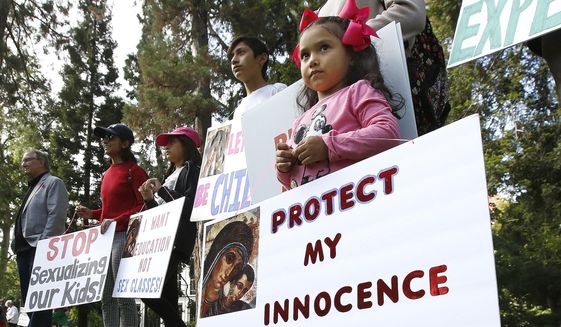
Angelie Reyes, 4, joins her family from Anaheim Hills to protest proposed changes to sex education guidance for teachers, Wednesday, May 8, 2019, in Sacramento, Calif. The California State Board of Education is set to vote Wednesday on new guidance for teaching sex education in public schools. The guidance is not mandatory but it gives teachers ideas about how to teach a wide range of health topic including speaking to children about gender identity. (AP Photo/Rich Pedroncelli)


Vatican City: The Vatican has issued an official document rejecting the idea that people can choose or change their genders and insisting on the sexual "complementarity" of men and women to make babies.
It said the idea of gender being determined by personal feeling rather than biology was an attempt to "annihilate nature".
Pope Francis walks past cardinals after celebrating a Pentecost Mass in St Peter's Square at the Vatican on Sunday.
Pope Francis walks past cardinals after celebrating a Pentecost Mass in St Peter's Square at the Vatican on Sunday.Credit:AP

Pope Francis has repeatedly argued the position that people cannot choose their genders. But the document represents the first attempt to put the Vatican's position, first articulated fully by Pope Benedict XVI in a 2012 speech, into a comprehensive, official text.
The document, published during LGBT Pride Month, was immediately denounced by LGBT Catholics as contributing to bigotry and violence against gay and transgender people. Advocacy group New Ways Ministry said it would further confuse individuals questioning their gender identity or sexual orientation and at risk of self-harm.

The text, Male and Female He Created Them, was intended to help Catholic teachers, parents, students and clergy address what the Vatican's Congregation for Catholic Education called an "educational crisis" in the field of sex education.
It called for a "path of dialogue" and listening on the issue of "gender theory" in education. But even priestly advocates for LGBT Catholics noted that the text appeared to have relied entirely on previous papal pronouncements, Vatican documents and philosophers and theologians.
"The real-life experiences of LGBT people seem entirely absent from this document," said the Reverend James Martin, a Jesuit priest who wrote a book on improving Catholic Church outreach to the LGBT community, titled Building a Bridge. "We should welcome the congregation's call to dialogue and listening on gender, and I hope that conversation will now begin."
Jay Brown of the Human Rights Campaign - the largest LGBT-rights group in the United States - said the Vatican's stance "sends a dangerous message that anybody who experiences gender diversity is somehow less worthy."

The document called for a new alliance among families, schools and society to offer a "positive and prudent sexual education" in Catholic schools so children learn the "full original truth of masculinity and femininity."

It called gender fluidity a symptom of the "confused concept of freedom" and "momentary desires" that characterise post-modern culture. It rejected terms such as "intersex" and "transgender" and said the purpose of the biological complementarity of the male and female sex organs was to ensure procreation.
Francis DeBernardo, head of New Ways Ministry, said such concepts are outdated, misinformed and ignore contemporary science on factors beyond visible genitalia that determine gender.
"Gender is also biologically determined by genetics, hormones and brain chemistry - things not visible at birth," DeBernardo said in a statement. "People do not choose their gender, as the Vatican claims, they discover it through their lived experiences."
He said the Catholic Church should encourage this process of discovery, saying it's "a process by which individuals discover the wonderful way that God has created them."
"This casts everything back to the Dark Ages," said Marianne Duddy-Burke, the executive director of DignityUSA, a group that advocates for LGBT equality and inclusion in the church. "I think it is incredibly insensitive, to be talking still about gender and sexuality as a choice and a momentary whim rather than a fundamental God-given identity."
The church's retrenchment hints at one of the challenges it faces at a time of growing secularisation - when many of its teachings on sexuality are being ignored as out of date. Francis has expressed an interest in outreach to LGBT followers, but he has also taken a clear stance on gender identity, decrying the idea that children are taught in schools that "everyone can choose his or her sex."
"And this is terrible," Francis said in 2016.
The church on Monday said it was important to listen and "understand cultural events of recent decades," but it also described a crisis in sexual education - a "disorientation" that was destabilising the family and cancelling out the differences between men and women.
The church made a case that children had the right to grow up in a family "with a father and a mother," and the document quoted an earlier Francis speech about how children benefit from seeing masculinity represented by the father and femininity represented by the mother.
"It is precisely within the nucleus of the family unit that children can learn how to recognise the value and the beauty of the differences between the two sexes," the document said.
Traditionalist groups lauded the 31-page Vatican document. CitizenGO, a conservative Madrid-based group that campaigns around the world, called the latest church teaching an "extraordinary guidebook."
"This authoritative tool is quite clear in the condemnation of gender ideology and of the grave damage it wreaks inside society," the group said.
….


AP, Washington Post

Friday, June 7, 2019

Until which “coming” would Apostle John live?


Image result for the apocalypse of john


Beyond the “Second Coming”
 

Part Two:
Until which “coming” would Apostle John live?


by
 
Damien F. Mackey


Peter turned and saw that the disciple whom Jesus loved was following them.
(This was the one who had leaned back against Jesus at the supper and had said,
‘Lord, who is going to betray you?’)
When Peter saw him, he asked, ‘Lord, what about him?’
Jesus answered, ‘If I want him to remain alive until I return,
what is that to you? You must follow me’.”
 
John 21:20-22


The Apostles of Jesus Christ were the types who were never going ‘to die wondering’.
Philip, for instance (John 14:8): ‘Master, show us the Father; then we shall be content’.
And Thomas (20:25): ‘Unless I see the nail marks in his hands and put my finger where the nails were, and put my hand into his side, I will not believe’.
Now Peter: ‘Lord, what about him [John]?’
 
Jesus often met such questions with a mild rebuke.
In the case of Philip (John 14:9-11):
 
Have I been with you so long, and yet you have not known Me, Philip? He who has seen Me has seen the Father; so how can you say, ‘Show us the Father’? Do you not believe that I am in the Father, and the Father in Me? The words that I speak to you I do not speak on My own authority; but the Father who dwells in Me does the works. Believe Me that I am in the Father and the Father in Me, or else believe Me for the sake of the works themselves’.
 
In the case of ‘Doubting Thomas’ (20:27): ‘Put your finger here; see my hands. Reach out your hand and put it into my side. Stop doubting and believe’.
In the case of Peter: ‘What is that to you?’, etc.
 
But there may now arise a modern question: If, as most Christians seem to believe, Jesus has not yet come as He spoke of to his disciples - {and as they (e.g. Sts. John, Paul) wrote of with phrases like “soon”, or even “very soon”} - in what Christians term (wrongly, I think) the “second coming”, then how is it that the risen Jesus can say that He wanted John ‘to remain alive until I return’?
This statement, by the way, is perfectly in accord with what the pre-Resurrection Jesus had told his followers (Matthew 16:28): ‘Truly I tell you, some who are standing here will not taste death until they see the Son of Man coming in His kingdom’.
Apparently, while Peter was not going to be one of these, John was.
Had Jesus Christ, who had risen from the dead by his own power, by the power of his Father (John 10:17-18): ‘The reason my Father loves me is that I lay down my life—only to take it up again. No one takes it from me, but I lay it down of my own accord. I have authority to lay it down and authority to take it up again. This command I received from my Father’, all of a sudden, despite his now being in a higher (transformed) state of being, become confused about when He would actually come again?
No, the fact is that there was a “coming” before the final coming, as I estimated in Part One: https://www.academia.edu/29837194/Beyond_the_Second_Coming_ thus:
 
As the Americans say, Let’s do the math.
 
First: “In the Gospel the Lord shows us that His first coming was in humility, as a Servant, to free the world from sin”. http://www.ewtn.com.au/devotionals/mercy/coming.htm
 
Second: His soon-to-take-place “coming” as gleaned from the quotes above, follows that one. And it is this particular “coming” that I would designate the “Second Coming”.
 
Last: There is yet to be a Final Coming, as indicated by the Catechism: “God's triumph over the revolt of evil will take the form of the last judgment after the final cosmic upheaval of this passing world” (No. 667). The Last Judgment.
 
Peter’s lifetime approximated to only the First of these.
John would live on until the Second.
We still await the Final coming of Jesus Christ.