Sunday, August 23, 2015

Now, the Kasper Theory of Democracy?

Image result for cardinal kasper history

by George Weigel

A few weeks ago, after Ireland voted to approve so-called “same-sex marriage,” a correspondent sent me an e-mail quoting Cardinal Walter Kasper’s comment on the result: “A democratic state has the duty to respect the will of the people, and it seems clear that, if the majority of the people wants such homosexual unions, the state has a duty to recognize such rights.” I certainly hope the cardinal was either misquoted or mistranslated. For that comment, taken at face value, would suggest that a distinguished theologian-bishop has seriously misunderstood the nature of democracy and the Church’s teaching about just political communities.
As quoted, that comment would also suggest—to raise a delicate point—a curious myopia on Cardinal Kasper’s part about his own national experience.
For the first word that came to mind on reading Kasper’s remark was “Weimar.” As in the Weimar Republic, which succeeded the Hohenzollern monarchy after World War I and was in turn succeeded by Hitler’s Third Reich—after a democratic election put Hitler and his Nazi Party in power, and after a democratically elected German parliament passed the notorious Ermächtigungsgesetz (“Enabling Act”), which effectively granted Hitler dictatorial powers.
John Paul II, whose teaching about the free and virtuous society in Centesimus Annus remains the pinnacle of Catholic social teaching on the democratic experiment, constructed his social magisterium beneath the shadow that “Weimar” had cast across the history and future of democracy. That is why St. John Paul taught that “democracy” can never be reduced to mere “majority rule.” Majorities can get the technicalities of public policy wrong. More gravely, majorities can also get the fundamentals of justice wrong: as many Germans did in the early 1930s, when the outcome of voting for the Nazi Party was clear to anyone who had read Hitler’s Mein Kampf or listened to his rants; as many French citizens did in the early twentieth century, when the representatives they democratically elected dismantled Catholic schools, exiled members of religious orders, and expropriated their property; and as too many Americans did during our long national struggle over racial segregation, legally imposed by democratically-elected legislatures.
That is why John Paul also insisted that, of the three interlocking parts of the free and virtuous society—a democratic polity, a free economy, and a vibrant public moral culture—the cultural sector is the key to the rest. For it takes a certain kind of people, formed in the arts of self-governance by a robust moral culture and living certain virtues, to operate the machinery of democracy and the free economy in ways that promote decency, justice, and solidarity, not degradation, injustice, or new forms of authoritarian bullying.
Cardinal Kasper’s comments, as reported and translated, also imply a rather strange understanding of what “rights” are. As Catholic social doctrine understands them, “rights” are not bequests of the state—even when the state is implementing in law what it believes to be the will of the majority of citizens. Rather, the Church teaches that basic civil and political “rights” are hard-wired into us as the means to fulfill our duties to God and to our neighbors. A morally well-formed civil society recognizes and cherishes those rights (such as religious freedom, free speech, and freedom of assembly) and a just state, acting as the servant of civil society, affords those rights the legal protection they are due.
None of this suggests that the just state has a “duty,” under any circumstances, to afford legal recognition to “homosexual unions” as if they were true marriages to which people have a “right”—which reason and revelation tell us they are not. A just state may well create legal arrangements in which citizens in a variety of relationships are legally and financially enabled to care for those for whom they believe themselves responsible. But that’s not what happened in Ireland, and it’s not what’s afoot elsewhere.
Democracy depends on a broad public consensus that there are Things As They Are, including moral Things As They Are. Absent that consensus, the shadow of Weimar lengthens, and threatens, yet again.
George Weigel is Distinguished Senior Fellow of the Ethics and Public Policy Center in Washington, D.C.
 
Become a fan of First Things on Facebook, subscribe to First Things via RSS, and follow First Things on Twitter.

....

Taken from: http://www.firstthings.com/web-exclusives/2015/06/now-the-kasper-theory-of-democracy

Euthanasia Debate With Archbishop Anthony Fisher OP and Prof Peter Singer Exposes Major Rifts in Culture

Image result for fisher and singer debate
 

Catholic Communications, Sydney Archdiocese,
14 Aug 2015


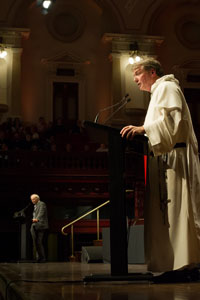
Archbishop Anthony Fisher OP - what kind of community will we be in the future?
Archbishop of Sydney Anthony Fisher OP said he was very pleased to debate Prof Peter Singer on the subject of euthanasia to a packed Sydney Town Hall.

"The debate was civil and probing and before a large audience, mostly of very thoughtful young people who were engaged with all the issues. It exposed some major rifts in our culture with respect to the vulnerable and those who are suffering, to healthcare and the law, and to the responsibilities of freedom," the Archbishop said following the Thursday evening debate.
The audience of around 1200 saw two well-prepared presenters. Archbishop Fisher is a prominent bioethicist, a leader in moral theology and philosophy and a formal lawyer.
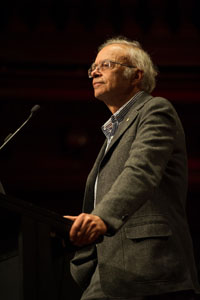
Prof Peter Singer is a moral philosopher at Princeton University specialising in applied ethics and former chair of the philosophy department at Monash University.
Their topic was "Should Voluntary Euthanasia be legalised?"

Around 1200 attended the debate at the Sydney Townhall
Archbishop Anthony has argued against euthanasia many times in articles and publications, interviews, addresses, homilies and debates.

Professor Singer has also written and lectured extensively on euthanasia as well as selective infanticide, abortion and animal rights.

The two men put their  case and rebuttal and took around forty minutes of questions from the audience, guided by the moderator Scott Stephens, he ABC's online editor of Religion and Ethics. Both had a strong support base in the audience.
Professor Singer wanted to stick strictly to the topic of voluntary euthanasia only for competent adults with a terminal illness -  no deviation, no broadening the discussion.

Prof Peter Singer is moral philosopher at
Princeton University
Archbishop Fisher argued the subject could not be kept within such narrow confines and was happy to take questions from a broader scope.
Reflecting on the debate, Archbishop Anthony said;" My big question was: who dies in a euthanasia regime? It is, of course, the frail, elderly, sick, lonely, disabled, babies.

'So what seems to me to be ultimately at issue is what kind of community we will be in the future: will it be one in which the young and frail, the sick and sorry, the depressed and disabled are devalued, and more and more at risk? Or one where they will be protected and nurtured?"

At the conclusion of the debate which was hosted by the Catholic Society of St Peter student association at Sydney University, Archbishop Fisher and Prof Singer exchanged copies of their latest books - although there is little doubt they are very familiar with each other's work.

....

Taken from: http://www.sydneycatholic.org/news/latest_news/2015/2015814_1904.shtml

Tuesday, August 4, 2015

Jacob's Ladder: Ten Steps To Truth. Peter Kreeft.

jacobs-ladder-cropped


There are ten important questions everyone should ask; and the answers to these questions, which lead to ultimate truth, are a matter of reason, not of faith.
Well-known Catholic philosopher and writer Peter Kreeft tackles each of these questions in a logical step-by-step way, like climbing the rungs of a ladder. Because questions are best answered by dialogue, Kreeft answers these fundamental questions in an imaginary conversation between two very different people who meet at the beach. Kreeft's characters begin at the beginning, at the bottom of the ladder, which is the passion for truth. When it comes to the most important questions a person can ask, no mere interest in philosophical dabbling will do. The passion for truth does not stop there, however, but carries the reader from one page to the next in this thought-provoking adventure of the mind.
Among the topics, or "steps", that Kreeft's characters delve into include:


  • Do you have the passion to know?
  • Does truth exist?
  • What is the meaning of life?
  • What is love, and why is it so important for our lives?
  • If there is a God, what proof is there for his existence?
  • Has God revealed himself to us in a personal way?


Peter Kreeft, Ph.D., a Professor of Philosophy at Boston College, is one of the most widely read Christian authors of our time. His many bestselling books include Back to Virtue, Because God is Real, You Can Understand the Bible, Angels and Demons, Heaven: The Heart's Deepest Longing, Fundamentals of the Faith, and A Summa of the Summa."Peter Kreeft is our generation's C.S. Lewis, as this brilliant new book of his further demonstrates. The genius of Jacob's Ladder lies in Kreeft's canny ability to capture the imagination with vivid and arresting prose while simultaneously leading the reader, step by step, above and beyond the cramped limitations of the imagination into the spacious and lofty heights of reason, reality, and truth."


- Patrick Madrid, author, Where is That in the Bible?"In this delightful and ingenious guidebook for living Catholic faith, Peter Kreeft removes most contemporary popular objections to embracing God, Jesus, and the Catholic Church. Using two characters, Mother, an imposing beach-going philosopher of life, and Libby, a 23-year old former journalist who has naively adopted the culture's critique of religion, Kreeft exposes the many fallacies in contemporary moral and philosophical relativism. By imparting a deeper insight into the ideal of passion, truth, meaning and love, Mother creates a light to shine upon the true, good, and beautiful character of principles, God, Jesus, and Catholicism. This is a "must read" for those seeking a way out of our cultural malaise."


- Fr. Robert J. Spitzer, S.J., Author, Five Pillars of the Spiritual Life
 "In Jacob's Ladder, Peter Kreeft offers a wonderful book for someone genuinely interested in asking profound questions and seeking profound answers. With clarity, wit, and insight, the characters of his dialogue consider some the most central questions in human life-including truth, meaning, love, God and Jesus-in a way both entertaining and accessible. The first chapter especially, considering and refuting various forms of relativism and subjectivism, is a necessary preamble to any serious discussion of anything."


- Christopher Kaczor, Author, The Seven Big Myths about the Catholic Church
"When I was coming into the Catholic Church 25 years ago, the voice that stood out for me more than any other on the contemporary scene as an oasis of clear and accessible sanity was Peter Kreeft's. Jacob's Ladder shows that a mind, heart and soul filled with Catholic teaching only becomes richer, deeper and more beautiful with time. Lift this joyous chalice to the lips of your soul and drink deeply. It is satisfying indeed!" - Mark Shea, author, By What Authority?


And many other important questions and topics to help climb the ladder to the truth about life.


....


Taken from: http://www.ignatius.com/Products/JACL-P/jacobs-ladder.aspx

Chesterton (1874-1936)


G. K. Chesterton (1874-1936) Author Page | Ignatius Insight


Articles By and About G. K. Chesterton
Ignatius Press Books about G. K. Chesterton
Books by G. K. Chesterton


G. K. Chesterton: “Who is this guy and why haven’t I heard of him?”


A pithy bio of G.K. Chesterton by Dale Ahlquist, President, American Chesterton Society
I’ve heard the question more than once. It is asked by people who have just started to discover G.K. Chesterton. They have begun reading a Chesterton book, or perhaps have seen an issue of Gilbert! Magazine, or maybe they’ve only encountered a series of pithy quotations that marvelously articulate some forgotten bit of common sense. They ask the question with a mixture of wonder, gratitude and . . . resentment. They are amazed by what they have discovered. They are thankful to have discovered it. And they are almost angry that it has taken so long for them to make the discovery.
“Who is this guy. . .?”


Gilbert Keith Chesterton (1874-1936) cannot be summed up in one sentence. Nor in one paragraph. In fact, in spite of the fine biographies that have been written of him, (and his Autobiography) he has never been captured between the covers of one book. But rather than waiting to separate the goats from the sheep, let’s just come right out and say it: G.K. Chesterton was the best writer of the twentieth century. He said something about everything and he said it better than anybody else. But he was no mere wordsmith. He was very good at expressing himself, but more importantly, he had something very good to express. The reason he was the greatest writer of the twentieth century was because he was also the greatest thinker of the twentieth century.
Born in London, Chesterton was educated at St. Paul’s, but never went to college. He went to art school. In 1900, he was asked to contribute a few magazine articles on art criticism, and went on to become one of the most prolific writers of all time. He wrote a hundred books, contributions to 200 more, hundreds of poems, including the epic Ballad of the White Horse, five plays, five novels, and some two hundred short stories, including a popular series featuring the priest-detective, Father Brown. In spite of his literary accomplishments, he considered himself primarily a journalist. He wrote over 4000 newspaper essays, including 30 years worth of weekly columns for the Illustrated London News, and 13 years of weekly columns for the Daily News. He also edited his own newspaper, G.K.’s Weekly. (To put it into perspective, four thousand essays is the equivalent of writing an essay a day, every day, for 11 years. If you’re not impressed, try it some time. But they have to be good essays, all of them, as funny as they are serious, and as readable and rewarding a century after you’ve written them.)
Chesterton was equally at ease with literary and social criticism, history, politics, economics, philosophy, and theology. His style is unmistakable, always marked by humility, consistency, paradox, wit, and wonder. His writing remains as timely and as timeless today as when it first appeared, even though much of it was published in throw away paper.
This man who composed such profound and perfect lines as “The Christian ideal has not been tried and found wanting; it has been found difficult and left untried,” stood 6’4″ and weighed about 300 pounds, usually had a cigar in his mouth, and walked around wearing a cape and a crumpled hat, tiny glasses pinched to the end of his nose, swordstick in hand, laughter blowing through his moustache. And usually had no idea where or when his next appointment was. He did much of his writing in train stations, since he usually missed the train he was supposed to catch. In one famous anecdote, he wired his wife, saying, “Am at Market Harborough. Where ought I to be?” His faithful wife, Frances, attended to all the details of his life, since he continually proved he had no way of doing it himself. She was later assisted by a secretary, Dorothy Collins, who became the couple’s surrogate daughter, and went on to become the writer’s literary executrix, continuing to make his work available after his death.
This absent-minded, overgrown elf of a man, who laughed at his own jokes and amused children at birthday parties by catching buns in his mouth, this was the man who wrote a book called The Everlasting Man, which led a young atheist named C.S. Lewis to become a Christian. This was the man who wrote a novel called The Napoleon of Notting Hill, which inspired Michael Collins to lead a movement for Irish Independence. This was the man who wrote an essay in the Illustrated London News that inspired Mohandas Gandhi to lead a movement to end British colonial rule in India. This was a man who, when commissioned to write a book on St. Thomas Aquinas (aptly titled Saint Thomas Aquinas), had his secretary check out a stack of books on St. Thomas from the library, opened the top book on the stack, thumbed through it, closed it, and proceeded to dictate a book on St. Thomas. Not just any book. The renowned Thomistic scholar, Etienne Gilson, had this to say about it:
“I consider it as being without possible comparison the best book ever written on St. Thomas. Nothing short of genius can account for such an achievement. Everybody will no doubt admit that it is a ‘clever’ book, but the few readers who have spent twenty or thirty years in studying St. Thomas. . . cannot fail to perceive that the so-called ‘wit’ of Chesterton has put their scholarship to shame. He has guessed all that which we had tried to demonstrate, and he has said all that which they were more or less clumsily attempting to express in academic formulas. Chesterton was one of the deepest thinkers who ever existed; he was deep because he was right; and he could not help being right; but he could not either help being modest and charitable, so he left it to those who could understand him to know that he was right, and deep; to the others, he apologized for being right, and he made up for being deep by being witty. That is all they can see of him.”Chesterton debated many of the celebrated intellectuals of his time: George Bernard Shaw, H.G. Wells, Bertrand Russell, Clarence Darrow. According to contemporary accounts, Chesterton usually emerged as the winner of these contests, however, the world has immortalized his opponents and forgotten Chesterton, and now we hear only one side of the argument, and we are enduring the legacies of socialism, relativism, materialism, and skepticism. Ironically, all of his opponents regarded Chesterton with the greatest affection. And George Bernard Shaw said: “The world is not thankful enough for Chesterton.His writing has been praised by Ernest Hemingway, Graham Greene, Evelyn Waugh, Jorge Luis Borges, Gabriel Garcia Marquez, Karel Capek, Marshall McLuhan, Paul Claudel, Dorothy L. Sayers, Agatha Christie, Sigrid Undset, Ronald Knox, Kingsley Amis, W.H. Auden, Anthony Burgess, E.F. Schumacher, Neil Gaiman, and Orson Welles. To name a few.
T.S. Eliot said that Chesterton “deserves a permanent claim on our loyalty.”
“. . . and why haven’t I heard of him?
There are three answers to this question:
    1. I don’t know.
    2. You’ve been cheated.
Chesterton is the most unjustly neglected writer of our time. Perhaps it is proof that education is too important to be left to educators and that publishing is too important to be left to publishers, but there is no excuse why Chesterton is no longer taught in our schools and why his writing is not more widely reprinted and especially included in college anthologies. Well, there is an excuse. It seems that Chesterton is tough to pigeonhole, and if a writer cannot be quickly consigned to a category, or to one-word description, he risks falling through the cracks. Even if he weighs three hundred pounds.
But there is another problem. Modern thinkers and commentators and critics have found it much more convenient to ignore Chesterton rather than to engage him in an argument, because to argue with Chesterton is to lose.
Chesterton argued eloquently against all the trends that eventually took over the twentieth century: materialism, scientific determinism, moral relativism, and spineless agnosticism. He also argued against both socialism and capitalism and showed why they have both been the enemies of freedom and justice in modern society.
And what did he argue for? What was it he defended? He defended “the common man” and common sense. He defended the poor. He defended the family. He defended beauty. And he defended Christianity and the Catholic Faith. These don’t play well in the classroom, in the media, or in the public arena. And that is probably why he is neglected. The modern world prefers writers who are snobs, who have exotic and bizarre ideas, who glorify decadence, who scoff at Christianity, who deny the dignity of the poor, and who think freedom means no responsibility.
But even though Chesterton is no longer taught in schools, you cannot consider yourself educated until you have thoroughly read Chesterton. And furthermore, thoroughly reading Chesterton is almost a complete education in itself. Chesterton is indeed a teacher, and the best kind. He doesn’t merely astonish you. He doesn’t just perform the wonder of making you think. He goes beyond that. He makes you laugh.

(Reprinted by kind permission of Dale Ahlquist and the American Chesterton Society.)

Dale Ahlquist is the president and co-founder of the American Chesterton Society.
He is the creator and host of the television series, “G.K. Chesterton: The Apostle of Common Sense,” on EWTN. Dale is the publisher of Gilbert Magazine, author of The Chesterton University Student Handbook, editor of The Gift of Wonder: The Many Sides of G.K. Chesterton, associate editor of the Collected Works of G.K. Chesterton (Ignatius). He has been called “one of the most respected Chesterton scholars in the world” and has delighted audiences around the country with his variety of talks on the great English writer. He is a graduate of Carleton College (B.A.) in Northfield, Minnesota, and Hamline University (M.A.) in St. Paul, Minnesota. He lives near Minneapolis with his wife and five children. Like Chesterton, Dale is a Catholic convert and a joyful defender of the Catholic Faith. He can be contacted at info@chesterton.org.


Related IgnatiusInsight.com Excerpts and Articles

How the Great Wind Came to Beacon House | G. K. Chesterton | Chapter One of Manalive
G.K. Chesterton, the Poet | Denis J. Conlon
St. Thomas More | G. K. Chesterton
A Simple Thought | G. K. Chesterton
The Problem of the Plantagenets | G. K. Chesterton
Chesterton and Orthodoxy | Carl E. Olson and Dale Ahlquist
Seeing With the Eyes of G.K. Chesterton | Dale Ahlquist
Recovering The Lost Art of Common Sense | Dale Ahlquist
Common Sense Apostle & Cigar Smoking Mystic | Dale Ahlquist
Chesterton and the “Paradoxy” of Orthodoxy | Carl E. Olson
The Attraction of Orthodoxy | Joseph Pearce
The Emancipation of Domesticity | G.K. Chesterton
The God in the Cave | G.K. Chesterton
What Is America? | G.K. Chesterton
Mary and the Convert | G.K. Chesterton
Chesterton and Saint Francis | Joseph Pearce
Chesterton and the Delight of Truth | James V. Schall, S.J.
The Life and Theme of G.K. Chesterton | Randall Paine | An Introduction to The Autobiography of G.K. Chesterton
Hot Water and Fresh Air: On Chesterton and His Foes | Janet E. Smith
ChesterBelloc | Ralph McInerny


Ignatius Press Books About Chesterton’s Life and Work


Classic Works by G.K. Chesterton


The Collected Works of G.K. Chesterton
Volume 1: Heretics, Orthodoxy, Blatchford Controversies (Softcover | Hardcover)
• Volume 2: St. Francis, Everlasting Man, St. Thomas (Softcover | Hardcover)
• Volume 3: The Catholic Church and Conversion; Where All Roads Lead; The Well and the Shallows; and others. (Softcover)
• Volume 4: What’s Wrong with the World, Superstition of Divorce, Eugenics and Other Evils (Softcover)
• Volume 5: The Outline of Sanity, The End of The Armistice, The Appetite of Tyranny, Utopia of Usurers, and more (Softcover)
• Volume 6: To be published
• Volume 7: The Ball and the Cross, Manalive, The Flying Inn (Softcover | Hardcover)
• Volume 8: The Man Who Knew Too Much, Tales of the Long Bow, The Return of Don Quixote (Softcover | Hardcover)
• Volume 9: To be published
• Volume 10: Collected Poetry, Part 1 (Softcover)
• Volume 10: Collected Poetry, Part 2 (Softcover | Hardcover)
• Volume 10: Collected Poetry, Part 3 (Softcover | Hardcover)
• Volume 11: Collected Plays and Chesterton on Shaw (Softcover)
• Volume 12: Father Brown Stories, Part 1 (Softcover | Hardcover)
• Volume 13: Father Brown Stories, Part 2 (Softcover | Hardcover)
• Volume 14: Short Stories, Fairy Tales, Mystery Stories (Softcover)
• Volume 15: Chesterton on Dickens (Softcover)
• Volume 16: The Autobiography (Softcover | Hardcover)
• Volume 17: To be published
• Volume 18: Robert Louis Stevenson, Chaucer, Leo Tolstoy, Thomas Carlyle (Softcover | Hardcover)
• Volume 19: To be published
• Volume 20: Christendom in Dublin, Irish Impressions, The New Jerusalem, A Short History of England (Softcover | Hardcover)
• Volume 21: What I Saw in America, The Resurrection of Rome, Sidelights (Softcover)
• Volume 22: To be published
• Volume 23: To be published
• Volume 24: To be published
• Volume 25: To be published
• Volume 26: To be published
• Volume 27: Illustrated London News, 1905-1907 (Softcover | Hardcover)
• Volume 28: Illustrated London News, 1908-1910 (Softcover | Hardcover)
• Volume 29: Illustrated London News, 1911-1913 (Softcover | Hardcover)
• Volume 30: Illustrated London News, 1914-1916 (Softcover | Hardcover)
• Volume 31: Illustrated London News, 1917-1919 (Softcover | Hardcover)
• Volume 32: Illustrated London News, 1920-1922 (Softcover | Hardcover)
• Volume 33: Illustrated London News, 1923-1925 (Softcover | Hardcover)
• Volume 34: Illustrated London News, 1926-1928 (Softcover | Hardcover)
• Volume 35: Illustrated London News, 1929-1931
• Volume 36: Illustrated London News, 1932-1934 (Softcover | Hardcover)


….


Taken from: http://www.ignatiusinsight.com/authors/gkchesterton.asp

Monday, July 27, 2015

Pope Francis' exhortation to walk on the margins makes us squirm


  • Pope Francis arrives to meet people gathered at a house as he visits Banado Norte, a poor neighborhood in Asuncion, Paraguay, on July 12. (CNS/Paul Haring)
 | 
Editorial
In the growing corpus of Pope Francis pronouncements -- in homilies and speeches and encyclicals -- an eloquence adheres that might safely be characterized as singular in quality in the long history of papal literature. It is an eloquence eminently accessible, born of personal experience and shaped primarily by his love of the poor.
It is not a distant love or a romanticized notion out of which he speaks. He doesn't make heroes of poor people or conjure some noble purpose out of poverty that will somehow be fully realized in the next life.
Quite the opposite. Transcendence is not reserved for some other reality. For Francis, the Christ we worship in the quiet of the sanctuary is the Christ of the streets. Francis is about real here-and-now situations in very plain language, and that language at times is disarmingly undiplomatic.
Indeed, in the United States, the eloquence is difficult to discern. The words make us squirm.
During his speech in Bolivia to members of popular movements, he said: "When we look into the eyes of the suffering, when we see the faces of the endangered campesino, the poor laborer, the downtrodden native, the homeless family, the persecuted migrant, the unemployed young person, the exploited child, the mother who lost her child in a shootout because the barrio was occupied by drug dealers, the father who lost his daughter to enslavement ... when we think of all those names and faces, our hearts break because of so much sorrow and pain. And we are deeply moved."
It was a telling moment. No one smirked or thought it an exaggeration that he places himself fully within those circles. He's been there. It is part of the authenticity that makes his words not only bearable when they might understandably repel, but actually inviting and enticing.
His exhortation to walk to the margins is not a rhetorical flourish; his now-familiar reference to the "art of encounter" is not metaphor. The images he supplies repeatedly in real time and circumstances demonstrate precisely what he means -- move into the margins of society among the broken, the disfigured, the financially destitute, those behind bars. They are the first preference for his attention and energy, the starting point from which flows his understanding of the heart of the Gospel and the Christian life.
How many of us have heard during a retreat or day of recollection some version of the "inverted triangle," a simple image to explain how the Christian understanding of what is important in life might be different from what is preached by Wall Street or the daily bombardment of ads encountered in every corner of life.
Francis goes deeper than explanation, well beyond mere tolerance. And this, perhaps, is what makes us nervous here in the First World, the developed world, the rich North. This pope is not ideological or partisan. He is radical in the most essential sense -- going to the root of things. It can't be overstated that an indispensable part of his formation occurred steeped in the "storms of people's lives" in the slums around Buenos Aires, Argentina. These are not places where one meets perfect nuclear Catholic families. These are not places of investment portfolios, career ladders, elegant dinners and heady intellectual conversation. These are not places that influence a country's economic or military policies. But they are his starting point, the first lens through which he views the rest of the world.
Those who wish to define Catholic orthodoxy by a narrow list of sexual sins are inclined to describe themselves as countercultural, fighting the mighty forces of secularism. Come September and Francis' visit, we all are likely to be shaken to our roots by a much-expanded definition of Catholic orthodoxy and a far more demanding idea of what it means to be countercultural in the United States.
"You, dear brothers and sisters, often work on little things, in local situations, amid forms of injustice which you do not simply accept but actively resist," he told the community activists in Bolivia. He was applauding them and their heroic work for "standing up to an idolatrous system which excludes, debases and kills."
Those in the room needed no further explanation of what he meant by "an idolatrous system." It is, in his words, "a globalization that excludes." He is about to arrive in globalization central.


....


Taken from: http://ncronline.org/news/faith-parish/editorial-pope-francis-exhortation-walk-margins-makes-us-squirm


Sunday, July 26, 2015

Planned Parenthood scam shows us evil has a way of creeping into the world

Image result for scary witches

Permalink                        

                        
THE gargoyle witches of Grimm’s fairytales, who kidnapped children and fattened them up to eat, served the purpose of warning tender hearts about the evil ever-present in our world.
As adults we still treat evil as the realm of alien monsters, consoling ourselves with the fiction that the butchers of Islamic State or Nazism or communism are not fully human, with people who love them and lives of normality outside their vile deeds.

 –, Saturday, July, 25, 2015, (10:18pm)                       

image
 
Hitler, for instance, was a vegetarian who cared deeply about the welfare of animals.
Aleksandr Solzhenitsyn once wrote that the line separating good from evil “passes not through states, nor between classes, nor between political parties either — but right through every human heart”.
In other words, all of us are capable of evil. It may be easier to think of evil as something foreign to ourselves. But it has a way of creeping into every complacent society, through every complicit heart.
Take the grotesque practices of one of the world’s largest abortion providers, Planned Parenthood, exposed in an undercover sting as selling the livers, brains and hearts of aborted babies for $30 to $100 a pop.
This is not just another wacky story from America to dismiss. We are deeply implicated, both because Australian researchers also use foetal tissue, whose provenance is opaque, and because we provide more than $30 million in foreign aid to the international arm of Planned Parenthood, for “reproductive health” activities in the Pacific and Asia.
You can see just what those “reproductive health” activities entail in two sickening undercover videos released by the US pro-life group, the Centre for Medical Progress.
Senior Director of Medical Services, Dr Deborah Nucatola is shown haggling over the sale of “intact” body parts over lunch with two actors she ­believes are from a “foetal tissue procurement” company.
In between forkfuls of lettuce and swigs of red wine, ­Nucatola says: “A lot of people want intact hearts these days … as many intact livers as possible … some people want lower extremities too … We’ve been very good at getting heart, lung, liver, because we know that, so I’m not gonna crush that part. I’m going to basically crush below, I’m gonna crush above, and I’m gonna see if I can get it all intact.”
Then there is stony-faced Dr Mary Gatter, another Planned Parenthood medical director, who offers to use “a less crunchy technique to get more whole specimens”. Consent from the patient for this altered technique she describes as a “specious little argument”.
Gatter is recorded negotiating $100 per body part. “I want a Lamborghini,” she quips.
Planned Parenthood claims it gains “no financial benefit”, other than to cover its costs, and is simply “helping” ­patients who want to “donate tissue ... with full, appropriate consent under the highest ethical and legal standards”.
The videos show abortion for what it is, not the sanitised fiction of the pro-choice movement, but the messy ending of a life, the crushing of a tiny body with a beating human heart and other organs desired by the medical research industry.
This secretive traffic in foetal body parts is a global business, and it occurs in Australia. Rare detail is found in a 2003 article in the Medical Journal of Australia, titled, “Use of human foetal ?tissue for biomedical research in Australia”.
An average of 108 aborted foetuses a year were “obtained” between 1994 and 2002: “19 separate biomedical researchers at 12 separate Australian institutions (four universities, six major teaching hospitals and two research ­institutes) used human foetal tissue in their research”.
The abortions were performed between eight and 20 weeks, and “the most commonly used tissues were eye (23%), bone/cartilage (23%), brain/spinal cord (22%), kidney (15%) and pancreas (8%).”
As in America, sale of foetal tissue here is illegal, but there is no transparency about the arrangements between abortion clinics and researchers, despite warnings from the ­National Health and Medical Research Council that “financial or contractual … conflict of interest” must be “managed”.
Alarmed by the prospect of similar abuses here, the Australian Christian Lobby has called on parliament to “investigate the use and possible sale of human foetal tissue”.
Then there is the not inconsiderable matter of taxpayer funding of the International Planned Parenthood Federation: $651,801 for “core funding to strategic plan (Asia)”, $769,800 “Contribution to IPPF (global)” and $30 million to “Pacific Regional Partnerships for Reproductive Health Program (Pacific)”.
NSW MP Fred Nile wants funding stopped: “The Australian Government is aiding the organisation’s unethical, inhumane practice of utilising foetal tissue as a commodity and for monetary gain.”
But the response of the government is just business as usual.
“These allegations … do not relate to DFAT’s funding of International Planned Parenthood Federation,” a spokesperson for the Department of Foreign Affairs said yesterday.
“DFAT contributes funding to IPPF as part of the global effort to reduce the unmet need for quality reproductive health care services in developing countries … IPPF must ensure its activities comply with the relevant country’s laws, including in relation to abortion”.
Sorry, that’s not good enough.
If the live cattle trade can be shut down overnight on the strength of undercover videos taken by animal rights activists, at the every least our government should review its funding of Planned Parenthood’s international affiliate, and seek assurances that foetal body parts are not being sold off.
Our consciences cannot remain forever anaesthetised to evil done in our name.
                

Monday, July 20, 2015

Pope Francis leading the new American (Socialist) Revolution


Image result for pope socialist revolution

Yes, Pope Francis is encouraging civil disobedience, leading a rebellion. Listen closely, Francis knows he’s inciting political rebellion, an uprising of the masses against the world’s superrich capitalists. And yet, right-wing conservatives remain in denial, tuning out the pope’s message, hoping he’ll just go away like the “Occupy Wall Street” movement did.
Never. America’s narcissistic addiction to presidential politics is dumbing down our collective brain. Warning: Forget Bernie vs. Hillary. Forget the circus-clown-car distractions created by Trump vs. the GOP’s Fab 15. Pope Francis is only real political leader that matters this year. Forget the rest. Here’s why:
Pope Francis is not just leading a “Second American Revolution,” he is rallying people across the Earth, middle class as well as poor, inciting billions to rise up in a global economic revolution, one that could suddenly sweep the planet, like the 1789 French storming the Bastille.


By


Unfortunately, conservative capitalists — Big Oil, Koch billionaires, our GOP Congress and all fossil-fuel climate-science deniers — are blind to the fact their ideology is on the wrong side of history, that by fighting a no-win battle they are committing suicide, self-destructing their own ideology.
The fact is: The era of capitalism is rapidly dying, a victim of its own success, sabotaged by greed and a loss of a moral code. In 1776 Adam Smith’s capitalism became America’s core economic principle. We enshrined his ideal of capitalism in our constitutional freedoms. We prospered. America became the greatest economic superpower in world history.
But along the way, America forgot Smith’s original foundation was in morals, values, doing what’s right for the common good. Instead we drifted into Ayn Rand’s narcissistic “mutant capitalism,” as Vanguard’s founder Jack Bogle called the distortion of Adam Smith’s principles in his classic, “The Battle for the Soul of Capitalism.” The battle is lost.
Pope Francis, leader of the coming 21st Century American Revolution
In the generation since the Reagan Revolution, America’s self-centered, consumer-driven, mutant capitalism lost its moral compass, drifting: Inequality explodes, income growth stagnates, the poor keep getting poorer. Yet across the world, billionaires have explode from 322 in 2000 to 1,826 in 2015, with 11 trillionaire capitalist families predicted to control the planet by 2100.
But not for much longer, as Pope Francis’ revolution accelerates, as his relentless socialist message of sacred rights for all people makes clear. Why? Our mutating capitalist elite have triggered a massive backlash, a “profound human crisis, the denial of the primacy of the human person. The worship of the ancient golden calf has returned in a new and ruthless guise in the idolatry of money.”
An aggressive Pope Francis is on a mission to transform the mutant ideology of today’s capitalist world with its rampant profits-centered climate-science denialism. Fortunately, the pope will soon confront and challenge America’s GOP Congress directly, then the United Nations General Assembly to challenge the capitalist world’s failure to take climate change actions. Maybe they’ll finally wake up.
Pope Francis’ recent trip to South America revealed a clear anticapitalism, socialist message, calling for a “structural change to a global economy that runs counter to the plan of Jesus,” as reported in Time by Christopher Hale. Francis warned:
“The future of humanity does not lie solely in the hands of great leaders, the great powers and the elites.” The future “It is fundamentally in the hands of peoples and in their ability to organize. It is in their hands, which can guide with humility and conviction this process of change. I am with you.” The pope is warning all capitalists everywhere. As Jesus says in the Bible, the poor will always be with you, but the rich may not be after the coming revolution.


....