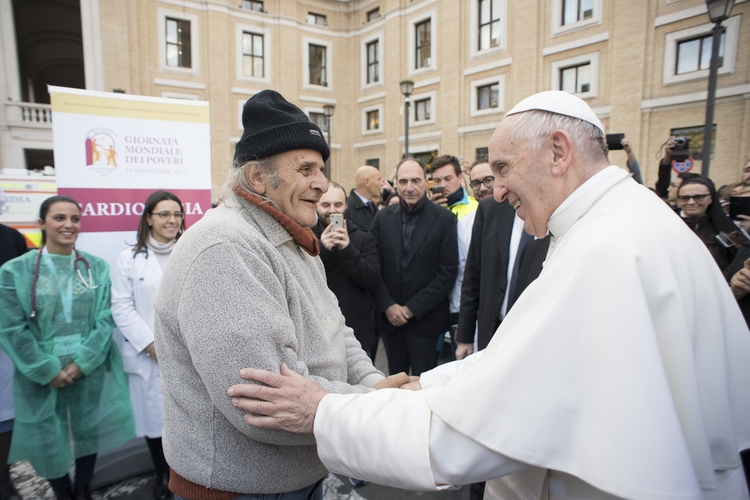
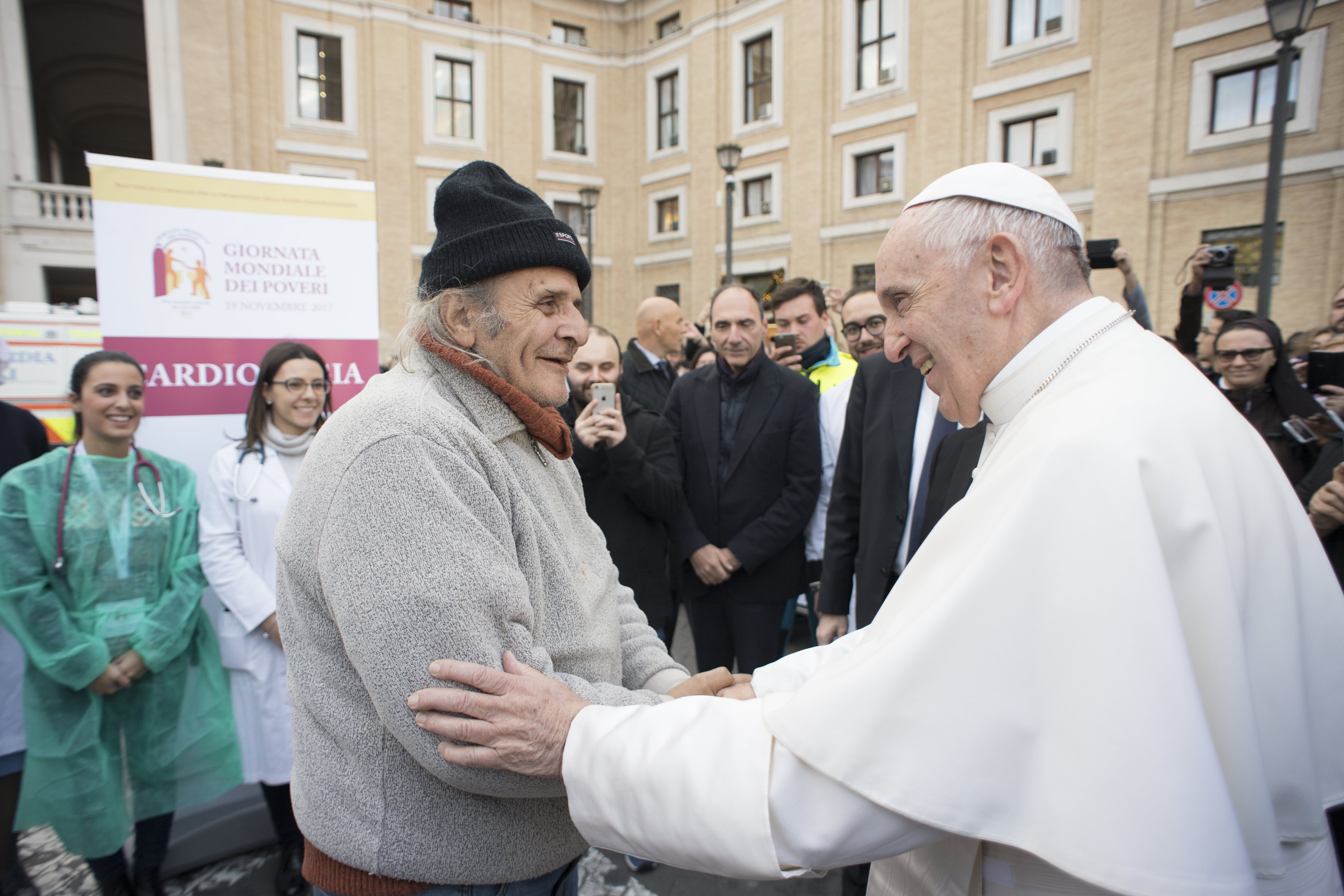
This morning, Pope Francis celebrated Mass for some 7,000 poor people in St. Peter’s Basilica, on the first World Day of the Poor.
Afterwards, he joined 1,500 of those who attended Mass for lunch in the Vatican’s audience hall, while the remaining thousands were given lunch in communities across the city, including at the North American College in Rome.
St. Peter’s Basilica has hosted many great events but never one entirely dedicated to the poor. At the end of the Jubilee of Mercy, Pope Francis decreed that every year, near the end of the church’s liturgical year, a World Day of the Poor is to be celebrated in dioceses and churches across the world, because “the poor are at the heart of the Gospel.”
“If in the eyes of the world the poor have little value, they are the ones who open to us the way to heaven; they are our passport to paradise,” Pope Francis said in his homily. “In the poor, we find the presence of Jesus, who, though rich, became poor for us.”
In the poor, we find the presence of Jesus, who, though rich, became poor for us.
Tweet this
The Mass was attended by poor people from Italy, France, Spain, Germany, Poland as well as migrants and refugees from across the world. Tony, a refugee from Syria, read one of the readings at Mass, while a Brazilian and Peruvian, who are being assisted by scholarships, read two of the prayers of the faithful.
Twelve minors, some of them migrants, served at the Mass, while a family living in precarious conditions, with a one-year-old daughter with cystic fibrosis, brought up the gifts at the offertory. At the offertory, a charitable organization which provides bread for the poor every day, brought up a quantity of bread, which was eaten later at lunch with the pope.
Francis expressed “joy” at celebrating the Eucharist—“the food for life’s journey”—with these attendees. “All of us, none excluded, need this,” he said. “For all of us are beggars when it comes to what is essential: God’s love, which gives meaning to our lives and a life without end.”
Later, commenting on the Gospel story of “the talents,” Pope Francis said: “Let us realize this: We do have talents; in God’s eyes, we are ‘talented.’ Consequently, no one can think that he or she is useless, so poor as to be incapable of giving something to others.”
He told his audience that “God, in whose eyes no child can be neglected, entrusts to each of us a mission.” He gives us talents “to use wisely” and bear fruit. The pope explained that the Gospel tells us the master “was displeased” with the one who did not use his talent but hid it under the ground—“his evil was that of failing to do good.”
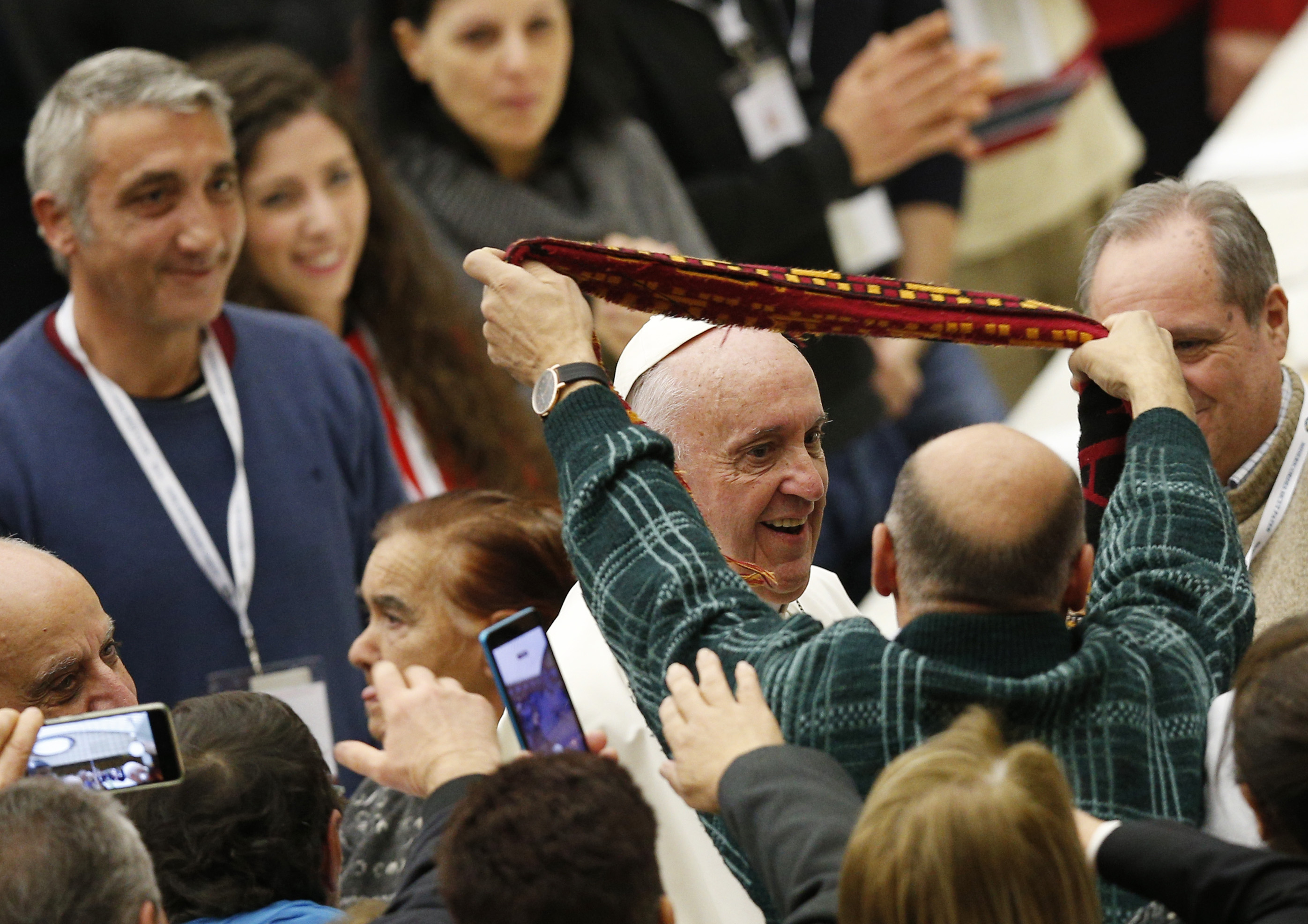
A man puts a bandanna on Pope Francis as he arrives to eat lunch with the poor in the Paul VI hall after celebrating Mass marking the first World Day of the Poor at the Vatican Nov. 19. Some 1,200 poor people joined the pope for the meal. (CNS photo/Paul Haring)
The Gospel tells us that “the one who adds new talents is truly ‘faithful’ because he sees things as God does,” said the pope. “He does not stand still, but instead, out of love, takes risks. He puts his life on the line for others; he is not content to keep things as they are. One thing alone does he overlook: his own interest. That is the only right ‘omission.’”
Pope Francis declared that “omission is also the great sin where the poor are concerned” and it is called “indifference.”
“It is when we say, ‘That doesn’t regard me; it’s not my business; it’s society’s problem.’ It is when we turn away from a brother or sister in need, when we change channels as soon as a disturbing question comes up, when we grow indignant at evil but do nothing about it. God will not ask us if we felt righteous indignation, but whether we did some good.”
“We please God,” the pope said, by showing love to “the hungry and the sick, the stranger and the prisoner, the poor and the abandoned, the suffering who receive no help, the needy who are cast aside. On their faces we can imagine seeing Jesus’ own face; on their lips, even if pursed in pain, we can hear his words: ‘This is my body.’”
Pope Francis told his worldwide congregation, “In the poor, Jesus knocks on the doors of our heart, thirsting for our love. When we overcome our indifference, and in the name of Jesus we give of ourselves for the least of his brethren, we are his good and faithful friends, with whom he loves to dwell.”
“We see true goodness and strength: not in closed fists and crossed arms, but in ready hands outstretched to the poor, to the wounded flesh of the Lord. There, in the poor, we find the presence of Jesus. For us it is an evangelical duty to care for them, as our real riches, and to do so not only by giving them bread, but also by breaking with them the bread of God’s word, which is addressed first to them.
To love the poor means to combat all forms of poverty, spiritual and material.
Tweet this
“To love the poor means to combat all forms of poverty, spiritual and material. And it will also do us good. Drawing near to the poor in our midst will touch our lives. It will remind us of what really counts: to love God and our neighbor. Only this lasts forever, everything else passes away.”
Greeting tens of thousands of pilgrims in St. Peter’s Square after Mass, Francis recalled that Blessed Solanus Casey, O.F.M., was beatified in Detroit yesterday. Of Father Casey he said: “He was a humble and faithful disciple of Jesus, and he distinguished himself by his tireless service to the poor.” Francis prayed that his witness may help priests, religious and lay people “to live with joy the bond between announcement of the Gospel and love of the poor,” as has happened in Rome and in dioceses around the world today.
He concluded with these words: “I hope that the poor will always be at the center of our communities, not only on occasions like this, but always, because they are in the heart of the Gospel, and in them we meet Jesus who speaks to us and appeals to us through their sufferings and their needs.”
….
Taken from: https://www.americamagazine.org/faith/2017/11/19/pope-francis-indifference-poor-great-sin
Vatican City Helping the destitute is the 'passport to paradise' for Christians, the Pope says, as he led mass for thousands of poor people in St Peter's Basilica.
Pope Francis celebrated the World Day of the Poor on Sunday with some 6,000-7,000 poor people from all over Europe.
They were taken to the Vatican by Catholic charities.
'(The poor) are the ones who open to us the way to heaven; they are our passport to paradise. For us it is an evangelical duty to care for them,' he said in a homily.
'All too often, we have the idea that we haven't done anything wrong, and so we rest content, presuming that we are good and just... But to do no wrong is not enough.'
During the service in St Peter's, Francis was assisted by 12 people - migrants, poor or homeless people - and one of the readings was delivered by a Syrian refugee.
After mass, about 1500 poor people were due to have lunch with the Pope, the Vatican said.
Francis, who calls himself 'a street priest,' said days after his election to the papacy in 2013, that he wanted to lead 'a poor church, for the poor.'
In an earlier article (Extra Ecclesiam nulla salus, Matrix Jan. 2015) we saw that the word ‘Catholic’ can be used in different senses. All Protestants have in fact a grasp of some truths of the Catholic Faith. If validly baptised – since there is only One True Church – they must have been baptised into that Church and therefore to be in a sense (badly instructed!) Catholics, for as long as they do not apostatize from whatever portion of Catholic truth they do grasp. Of course, this assumes they are not to blame for their ignorance of the truth of Catholic claims. In cases where they are to blame, to a level which is mortally sinful, then for as long as this lasts there is no sense in which they are Catholic and hence no way in which they can be saved (cf. Lumen Gentium 14). If, however, their ignorance is invincible then these ‘Protestant Catholics’ provide us with a way of seeing how there can be “ecumenical dialogue” also between self-styled Catholics.
Perhaps a little of my own history will help. The places where I studied as a seminarian included some of the most prestigious universities in the world bearing the name of Catholic (and even Pontifical!). And yet, I was asked to imbibe all manner of anti-Catholic doctrine; to give just a few examples, that Our Lord did not really raise Lazarus from the dead; that there are contradictions in Scripture; that there have been only three instances of papal infallibility in 700 years; that Our Lady is not Co-Redemptrix; that no angels or devils exist; that every baby dying without Baptism – and for that matter everyone else! – goes to Heaven. And the interesting thing was that these doctrines were not always being propounded by your “cartoon” liberal, but sometimes by very devout priests; quite possibly better priests than I have become.
I also remember as a seminarian speaking with a priest who was ordained well before Vatican II, when candidates were still required to take the Anti-Modernist Oath. His class was told ‘It’s a mere formality. Just rattle it off; you don’t have to mean it’. (This is reminiscent of what St Pius X supposedly replied when complimented for having eliminated Modernism: ‘Oh, I have not eliminated it. I have merely driven it underground’.) Clearly then, the famous comment from Blessed Paul VI about the smoke of Satan entering the Church, should be backdated by not a few years.
Traditionally the Church has exercised greater rigour in dealing with apostates such as Luther, than with those brought up in Lutheranism or other heresies, who may not know any better. Given the generational heresy within the outward confines of the Church – often even taught in seminaries – when faced with heresy from a purported Catholic we should say in the words of Pope Francis ‘Who am I to judge?’. The heresy may be material rather than formal. Indeed, confusion within the Church has now reached such a point that often heresy has become the new orthodoxy! Those who maintain traditional Catholic doctrine – eg on the absolute inerrancy of Scripture – are frequently looked at askance as being out of step with how the Church is now.
In this sad state of affairs how are we to conduct ourselves? Firstly by remembering that, in the words of St Francis de Sales, ‘a spoonful of honey catches more flies than a barrelful of vinegar’, and that, as pointed out by St Peter Favre, ‘In order to help heretics it is first necessary to love them very sincerely’. That is so particularly regarding our ‘Catholic heretics’ of today.
What about “ecumenical dialogue” between more orthodox-minded Catholics, and Catholic heretics? This may be of use in some cases. However there needs to be more dialogue on the value of dialogue. Often it is pointless even making the attempt, because the Catholic heretic, secure in possession of what he perceives to be the new orthodoxy, steadfastly rejects Catholic Truth, which he perceives as the new heresy. Therefore often we are better off attending more Masses, praying more Rosaries, doing more fasting and so forth. As for “action”, we must remember that St Peter Claver, before preaching to the African slaves, first gained their goodwill by gifts of food etc. So too, often it is necessary to soften up the “enemy” position with the artillery bombardment of love, before sending in the “ground troops” of “ecumenical dialogue”.
In this centenary of Fatima we recall Our Lady’s message, there and elsewhere, calling us to prayer and penance. With the Church in its current state, sometimes the greatest penance can be to keep our spirits up! And to remember that the Church will not always be like this. To quote Fatima again ‘In the end My Immaculate Heart will triumph’.
Vatican City, Oct 23, 2017 / 10:20 am (CNA/EWTN News).- Pope Francis preached Monday about the idolatry of money, which causes us to ignore those in need, allowing others to go hungry and die while we turn money and worldly possessions into false gods.
Today there are people who are greedy for more money and worldly goods, people who have “so much,” but walk by “hungry children who have no medicine, who have no education, who are abandoned,” he said Oct. 23 during his homily at Mass at the chapel of the Vatican's Casa Santa Marta.
This is “an idolatry that kills,” that makes “human sacrifices” to the god of money, the Pope said.
“This idolatry causes so many people to starve,” he stated, pointing to the example of the hundreds of thousands of Rohingya people who have been displaced from their home in Burma, also known as Myanmar, due to ethno-religious persecution.
There are 800,000 Rohingya people in refugee camps, the Pope said. And of these, 200,000 are children. They are “malnourished, without medicine,” he said.
“Even today this happens,” he emphasized, noting how our prayers against idolatry “must be strong.”
We should pray: “Lord, please, touch the hearts of these people who worship… the god of money. Touch also my heart so I do not fall into” the same thing, that I can see everything clearly, he said.
The Rohingya are a predominantly Muslim ethnic group who reside in the Rakhine state of majority-Buddhist Burma. They have been denied citizenship for nearly 40 years, and their persecution by the government has intensified in recent years.
Pope Francis has spoken out on behalf of the minority many times in recent years. In November he will visit Burma, as well as Bangladesh, where he will undoubtedly speak out for the rights of religious and ethnic minorities.
In his homily, he reflected on the words of Christ in the day’s Gospel from St. Luke: “Take care to guard against all greed, for though one may be rich, one’s life does not consist of possessions.”
God who ultimately puts a limit on our attachment to money, Pope Francis said, since at the end of life it becomes worthless.
Many men worship money and make money their god, he continued, but their life has no meaning.
“Thus will it be for the one who stores up treasure for himself but is not rich in what matters to God,” Francis said, quoting from the Gospel of Luke.
God underlines this with “gentleness” in the end, he said. To make ourselves rich in what matters to God, “that is the only way. Wealth, [yes], but in God.”
....
Taken from: https://www.catholicnewsagency.com/news/an-idolatry-that-kills-pope-francis-on-greed-76687
WhenVladimir Lenincoined the phrase “useful idiots” in politics, he gave us a handy way of understanding Bill Shorten’s Labor Party.
Asidentity politicshas taken hold of our major public institutions and private companies, Labor politicians have played along.
In wanting to help so-called “oppressed minorities”, they have fallen into the trap of naively assisting the far more dangerous agenda of cultural Marxism.
media_cameraMark Latham. Picture: Harold David
In the eyes of this far-Left movement, they are very useful idiots.
With the fall of theBerlin Wall in 1989, most people thought Marxism had been defeated.
But this was only true of economic Marxism — government control of the means of production.
Like a scene from a Terminator movie, neo-Marxists reassembled themselves, morphing into an even more menacing force.
They adopted the tactics of the Italian writer Antonio Gramsci (1891-1937). Instead of seeking economic control, they pursued cultural control by manipulating the beliefs, values and language of society.
Gramsci proposed a “long march through the institutions”, steadily taking over universities, schools, media outlets and government agencies by appointing like-minded people to senior positions.
media_cameraKarl Marx argued for state control of production.media_cameraAntonio Gramsci argued that socialists should first control culture, beliefs and values of a society before being able to control the economy.
Sound familiar?
This is what has happened to Australia over the past 20 years. Political correctness is being used to control our language.
Gender fluidity courses in schools are being used to teach young people there is no such thing as fixed, biological science.
Post-structuralist Marxism is now the dominant ideology in Australia’s universities, such that students are being made to “unlearn” all prior knowledge and to regard history, science and even education itself as “capitalist constructs”.
Employment quotas and theories of “unconscious bias” are dismantling merit-based recruitment, with people hired by the medieval habit of how they look (skin colour and gender).
The overall impact has been to create a society devoid of certainty, drained of institutional ballast.
Cultural Marxism aims to convince people their true beliefs and identities in life are being repressed, that in feeling anxious and uneasy, they need to rise up against the existing social order.
It’s a powerful movement that started in the underbelly of our institutions and now dominates around 80 per cent of Australian public life.
The rest of us, the 20 per cent, are the resistance.
I say these things from a background in the right-wing of the Labor Party, where I fought the Left internally on most issues.
But I’m not the only one saying it.
Peter Baldwin, the intellectual leader of the Socialist Left faction in the period of the Hawke and Keating governments, has been making similar points.
He has called for a new political alliance: for conservatives, libertarians and traditional social democrats to unite in preserving the values of the 17th-century Enlightenment.
To fight for fraternity: bringing people together in common cause.
This is where Shorten and Labor have lost the plot. Identity politics is an incredibly divisive doctrine.
It pits Australians against each other: black versus white, female versus male, gay versus straight.
The neo-Marxists like it this way, as it creates the preconditions of political unrest: large parts of society agitating on spurious grounds.
Why would Labor ever endorse it?
media_cameraOpposition Leader Bill Shorten sees Aboriginals, migrants and females as victims, according to Mark Latham. Picture: Kym Smith
The founding purpose of social democracy is to encourage co-operation between people, transcending self-interest and superficial differences such as skin colour.
Under Shorten’s leadership, the ALP has ditched this kind of thinking.
It’s now a wholly owned subsidiary of identity politics, where questions of race, gender and sexuality are central to its policymaking.
Shorten believes Australia is so bigoted that a democratic vote on same-sex marriage would force large numbers of gay people to kill themselves — a false prophecy.
He sees Aboriginal, migrant and female Australians as victims of institutionalised prejudice.
He has said an ALP government will actively discriminate in favour of these groups.
This means more safe space segregation, more language policing, more radical gender theory, more job quotas and more damaging social division.
In effect, the Daniel Andrews Labor model in Victoria will be imported to Canberra.
These policies are not only wrong but unnecessary. Research has consistently shown Australia to be one of the most tolerant nations on earth.
A major study inside the Prime Minister’s Department earlier this year found that, if anything, we tend to overcompensate in supporting women, migrants and Aborigines, in giving them a fair go.
media_cameraMark Latham believes the Yes campaign is remarkably unconcerned by the need to protect religious freedoms. Picture: AAP
For the cultural Marxists, the purpose of identity politics is not to empower so-called minorities but to tear down perceived majorities — most notably, white straight men.
In the same-sex marriage debate, for instance, the Yes campaign is remarkably unconcerned by the need to protect religious freedoms.
Christians are expected to suffer into the future, just as gays claim to have suffered in the past.
Similarly, radical left feminists are not intent on empowering women, but disenfranchising men — to make them pay for past perceptions of privilege.
Recently, a Mark Latham’s Outsiders viewer wrote to me describing how, in his workplace in Melbourne, men were being sacked under a policy of eliminating “stale, pale males”.
Division of this kind is sparking bitter resentment.
It’s destroying social capital and the cause of Labor.
The one person with a moral duty to speak out against it is Shorten.
Yet he sees his role as egging it on.
This is a stunning betrayal of social democracy: a Labor leader who has lit a Bonfire of the Vengeances, with Australians fighting each other on the basis of race, gender and sexuality.
Truly a useful idiot.
….
Taken from: http://www.dailytelegraph.com.au/news/opinion/mark-latham-alp-is-full-of-useful-idiots-assisting-cultural-marxism/news-story/6425b58d26c78ec0659d9d225a194608?nk=b88dad37a2c83b63e4079d919c47e3e0-1508190807
In his Sunday Angelus address in St. Peter's Square, Pope Francis used the day's Gospel reading from Matthew about the master of a vineyard who hires tenants to oversee it, to impress upon the audience that God "though disappointed by our sins and our errors, does not go back on his word, he does not stop and above all does not take revenge!”
Pope Francis greets pilgrims in St. Peter's Square before his Wednesday general audience, Dec. 2, 2015. (Credit: Daniel Ibaez via CNA.)
VATICAN CITY – On Sunday Pope Francis said the new and unique perspective offered by Christianity is an attitude of love, rather than revenge, which God continues to adopt even in the face of our sins and errors.
“Here is the great novelty of Christianity: a God who, though disappointed by our sins and our errors, does not go back on his word, he does not stop and above all does not take revenge!” the Pope said Oct. 8.
“God loves, he doesn’t take revenge! He loves, and waits to forgive us,” Francis said, explaining that like the Israelites in salvation history, God calls each of us to form a relationship, an alliance, with him.
And “the urgency of responding with good fruits to the call of the Lord, who calls us to become his vineyard, helps us to understand what is new and unique in Christianity,” he said.
“This is not so much the sum of prescripts and moral norms, but it is first of all a proposal of love that God, through Jesus, made and continues to make through humanity,” he said. “It’s an invitation to enter this story of love, becoming a living and open vine, rich in fruit and hope for all.”
Francis spoke to pilgrims present in St. Peter’s Square for his Sunday Angelus address, which he centered on the day’s Gospel reading from Matthew that recounts how the master of a vineyard hires tenants to oversee it.
However, the tenants mistreat and kill his servants when the master sends them to collect the fruits. The tenants, Francis said, “assume a possessive attitude: they don’t consider themselves simple managers, but owners,” and refuse to hand over the crop. Even when the master sends his son, the tenants kill him in hopes of taking the son’s inheritance.
In his speech, the pope noted that this parable offered by Jesus illustrates in “an allegorical way” the warnings and rebukes given by the prophets in the history of Israel.
This is also a story that belongs to us, he said, because it speaks of the alliance God wanted to establish with humanity, and which he also calls each of us to participate in. However, like any “love story,” this history of alliance with God “has its positive moments, but it is also marked by betrayals and refusals.”
To understand how God responds to the refusals opposed to his love and his proposed alliance, the Gospel passage puts forth the question on the lips of the master: “What will the owner of the vineyard do to those tenants when he comes?”
Both this question and Jesus’ response about the stone rejected by the builders becoming the “cornerstone” of a new foundation, Francis said, highlight “that God’s disappointment for the wicked behavior of mankind is not the last word!
“Through the ‘discarded stones’ – and Christ is the first stone that the builders rejected – through situations of weakness and sin, God continues to circulate the ‘new wine’ of his vineyard, which is mercy,” he said.
And the only thing that can impede the “tenacious and tender” will of God, he said, is “arrogance and presumption, which at times even become violence!”
Faced with these attitudes, rather than going back on his promise, God “retains all his power to rebuke and admonish,” telling the arrogant and presumptuous that “the Kingdom of God will be taken from you, and it will be given to a people that will bear fruit.”
We too are invited to become part of God’s vineyard and to bear good fruit, Francis said, but stressed that in order to do so, we must be open.
“A vine that is closed can become wild and produce wild grapes,” he said. “We are called to go out of the vineyard and put ourselves at the service of our brothers who are not with us, to shake up and encourage each other, to remind each other that we must be the vine of the Lord in every environment, even the most distant and uncomfortable.”
The pope closed his address asking for Mary’s intercession in helping each of us “to be everywhere, especially on the peripheries of society, the vine that the Lord has planted for the good of all.”
Australia’s oldest and most prestigious institution of higher education, the University of Sydney, has reached an all- time low. In a remarkable act of institutional suicide, the university has introduced a compulsory initiative to “unlearn”.
In one fell swoop, it has done itself out of a job.
Dr Bella d'Abrera. Picture: Stuart McEvoy for the Australian.
In other words, it’s telling students to forget any preconceived ideas they might have about such things as “truth”, “love”, “medicine” and “criminal”, and to replace them with new ones.
And if you think “truth” is objective, think again.
According to the university, we live in a post-truth world, where everything is true and everything is false.
One of its Orwellian “Post Truth” initiatives is to be the authority for fact-checking fake news. But how will it do this if it doesn’t believe in truth or facts in the first place?
Unsurprisingly, the section on “love” is a pitch for same-sex marriage. Modern “medicine” it continues, might just be overrated.
The Quadrangle at the University of Sydney. Picture: AAP
On Tuesday, the university ventured out of academia into the world of commerce by issuing a press release in which a leading researcher at the University of Sydney Business School urged both students and the rest of society to unlearn the traditional idea of profit and loss in order to build a “sustainable future”.
Just how depriving Australians of the ability to earn a living will “help the community” is an unfathomable mystery.
It’s now clear that even the ideas of economics are being railed against in order to perpetuate issues such as climate change, sustainability and identity politics nonsense.
Speaking of money, will the university continue to accept the federal Government’s Australian Awards for outstanding contributions to Learning? Surely this would completely contradict this campaign of unlearning.
The Unlearn initiative is completely and utterly at odds with the purpose of education, which is to impart knowledge and to hone the mind.
It’s the exact opposite of curiosity, of progress, of the human thirst for knowledge and a desire to improve both our lot and the lot of others.
Instead, it is promoting unlearning, unknowing and encouraging incuriousness.
So much for the Enlightenment. Without knowledge, it’s impossible to be creative.
When William Charles Wentworth, who is no doubt turning in his grave, first proposed the idea of Australia’s first university in 1850, he envisaged an establishment in which all Australians from every class would be given the opportunity to “become great and useful in the destinies” of this country.
It’s hard to see how students who have been uneducated and deprived of knowledge at the taxpayers’ expense will be of any use to anyone, let alone the future of Australia.
The University of Sydney has gone from teaching students how to think, to what to think, to not to think at all. It is going to produce a generation of ignoramuses.
What then, is the point of sending your children to school at all, if everything they learn will be undone at university? This brave new world will be an easy one for academics who might otherwise be expected to know things.
But it would be a mistake to attribute this lunacy only to self-interest. The entire escapade is part of a broader, postmodern movement which has manifested itself as identity politics. Identity politics is a critique of our established institutions and norms, such as equality before the law, parliamentary democracy and freedom of speech.
Our established values, customs and history don’t represent the diverse, racial, cultural and gender identities of today, so they must be destroyed.
Identity politics is revolutionary. It says that these institutions are used to oppress, and as long as they exist, groups in society will suffer. So they must be torn down and we must start again.
Racks of human skulls and bones from slaughtered Cambodians as part of the Khmer Rouge. Picture: Getty Images
During the French Revolution, after the abolition of the monarchy, they declared it to be Year I. When the Khmer Rouge took over Cambodia in 1975, they declared it to be Year Zero. This might be Year -1, the complete negation of history.
And the proponents of this ideology have given up being subtle about it. In this latest operation, the university has openly adopted the pattern of teaching which has been eating away at academia since the 1960s. It’s there, written large on the website.
The “unlearn” initiative is about “breaking down old rules so we can write new ones”.
This is not about freedom, but rather indoctrinating students into a new religion of ignorance, a new kind of groupthink.
The proponents of unlearning ask: “Imagine what could be possible if we all learn to unlearn.”
But if we go down this regressive road of unlearning, nothing will be possible at all.
Dr Bella d’Abrera is the Director of the Foundations of Western Civilisation Program at the Institute of Public Affairs.
 (CNS photo/L’Osservatore Romano)
 (CNS photo/L’Osservatore Romano)